June 23, 2026

Brazil are fixated on Neymar and Endrick – but it’s Matheus Cunha who looks like their saviour


 The waves got bigger and bigger, waves of criticism crashing against Carlo Ancelotti. Detractors said Brazil did not have a settled line-up and lacked identity. They pulled apart his choices against Morocco; Roger Ibanez at right-back, Igor Thiago up front. Why, Carlo? Why? Then his substitutions at MetLife came under scrutiny. Ancelotti made five of them. But Endrick, he didn’t get on. Why, Carlo? Why? The waves continued. Raphinha looked lost Brazil’s opening match, an underwhelming 1-1 draw. Did he not need more detailed tactical instruction? What value, if any, have you brought to the national team, Carlo? An eyebrow arched. The waves swept over him. They did not take him under.

Pressure? “I mean it’s actually a privilege,” he said. If there’s anyone who can handle choppy waters, it’s ‘Anselocci’. Over the last week at the New York Red Bulls training facility in Morris Township, New Jersey, the 67-year-old Italian watched the waves and came to a realisation. He needed a surfer. Matheus Cunha was one of two changes Ancelotti made against Haiti. He decided to replace Igor Thiago, the Brentford striker, who will rue the chance he missed early on against Morocco when Vinicius Jr stood up a cross for him, which he glanced agonisingly wide.

Whether it’ll be Thiago’s last chance remains to be seen. It is a long tournament and, as Ancelotti said last week, you don’t judge a team or this group of players on their first game at the World Cup. As the waves battered him, he called for patience. Spain lost to Switzerland in 2010. Argentina suffered a shock defeat to Saudi Arabia in 2022. Both recovered to win the tournament.

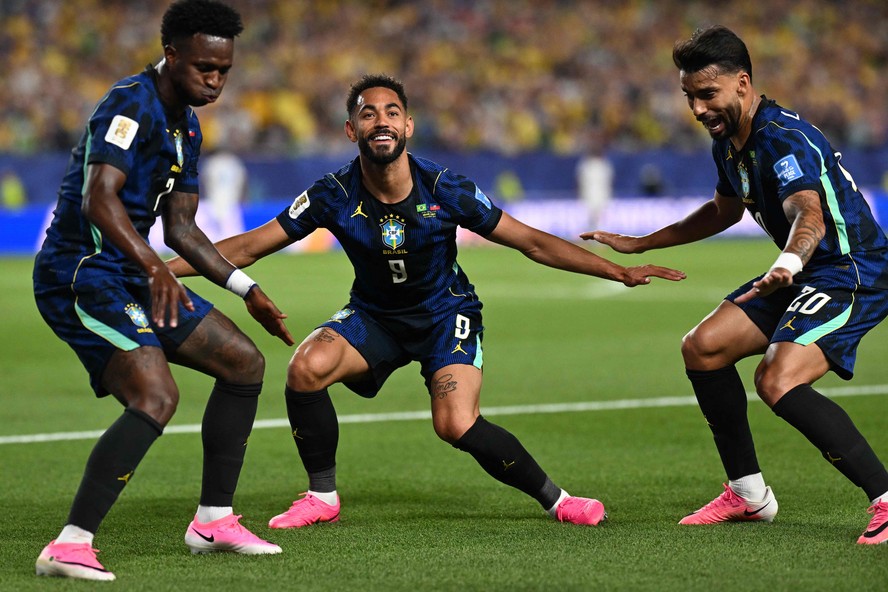
Cunha scores his second goal against HaitiKevin C. Cox/Getty Images

At Lincoln Financial Field on Friday, Cunha pulled on Brazil’s navy No 9 jersey. Overlooked at the last World Cup in Qatar, when he didn’t make the final squad, this was his moment. Ancelotti likes Cunha for the same reason Manchester United do. “We can talk about his technical abilities and he can play in three different positions,” United’s CEO Omar Berrada said. “He’s a playmaking attacking midfielder; he can score goals, he can make assists. I think he’s going to lift people off their seats. He’s got a bit of a swagger about him that people are going to really like.” What the marketing execs behind Brazil’s branding call Jogo Bonito.

Except, how many people were calling for Cunha’s introduction to the team?

The media were hardly campaigning for his involvement. Brazilians wanted to know about Neymar instead. When will he be back? Is he fit again? No, he isn’t. Neymar didn’t travel to Philadelphia with the squad. “He will remain in New Jersey to make the most of the final stage of his recovery, making use of the excellent facilities at The Ridge hotel and the Columbia Park training centre,” a statement from the CBF read. So the clamour shifted from Neymar to Endrick.

First, after the Morocco game. Then, before the Haiti game. Isn’t it time for Endrick, Carlo? Come on, please. “Endrick is very talented, an extraordinary talent,” Ancelotti said. “And of course Brazil will benefit from his quality at this World Cup but also in the next World Cup. Endrick is patient. He’s in no rush.” But Brazil is.

Real Madrid paid nearly €50million for the teenager in 2024. He was involved in 15 goals whilst on loan at Lyon in the second half of last season. He’s the next craque, a player who matches the idea of what Brazil thinks a national team player should be. Ancelotti seemed to bow to public pressure to include Neymar in his squad. Would he do the same with Endrick and name him in the starting XI? “It’s hard when you’re in competition with your friends,” Cunha said. “But we see it as a positive thing. When the team is picked, it might be good for one, bad for another.” The one Ancelotti selected was good for Cunha and good for Brazil.

 
Granted, Haiti rank 87th in the world. Granted, Honduras were 3-0 up against them at half-time in the autumn of last year too. But Brazil did look a little more like Brazil.

Bruno Guimaraes and Lucas Paqueta played guileful defence-splitting passes. Casemiro tried balls over the top. Raphinha had a lovely goal disallowed for offside. He then pulled up injured and we were reminded of the talent Brazil have on the bench, as Rayan came on. But the night belonged to Cunha. He came short and linked the play. He won the ball back and launched attacks. He connected with Vini Jr in a 4-2-4 that has its merits against a team of Haiti’s calibre.

Cunha was able to deploy his surfing celebration twice during Friday’s game in PhiladelphiaMauro PIMENTEL / AFP via Getty Images

Waves of attacks were launched and Cunha scored twice on his World Cup debut. He followed up a parried shot and got lucky as a clearance ricocheted off him into the net. As for his second, Paqueta won the ball back, Vini Jr slipped him through and Cunha dispatched an emphatic near-post finish.  He celebrated both as if paddling out to catch a wave, tube riding the critics. “I try to surf when I go to Brazil,” Cunha explained. “I go to a little village around my city. They taught me how to start surfing and now I’m considered a surfer guy.”

He has kept it up in England. “I go to Bristol, but it’s so cold, the water. I need to improve my level.” Cunha lifted Brazil’s at this World Cup.

Asked if the 27-year-old will start against Scotland in Miami, Ancelotti limited himself to say: “He may.” Neymar could be back by then and, in the meantime, Endrick remains an obsession. “I hope that he becomes one of the great Brazilian players,” Cunha magnanimously said. “He has already given the people a lot of joy, playing for Palmeiras and, at other moments, for Brazil. His quality is clear. We’re always messing around with him. He’s very humble, always asking for advice.”

Twice during the game at the Lincoln Financial Field, the Brazil fans unfurled a fluttering banner celebrating five icons of five World Cup-winning teams; Didi, Garrincha, Pele, Romario and Ronaldo. Afterwards, in the stadium’s underbelly, Kaka, Rivaldo and Bebeto mingled with fans. Waves of nostalgia remain powerful when it comes to Brazil.

Surfing them has proven too tough for too many of this generation and the last. Take Fred and Richarlison. But maybe not Cunha.

THE NEW YORK TIMES 


Cristiano Ronaldo social media storm reveals the dystopian backdrop to this World Cup


NICK MILLER 

It started with a fairly standard post-match interview.

After Portugal’s 1-1 draw with DR Congo in their opening game of the World Cup, midfielder Joao Neves was asked about Cristiano Ronaldo who, you may have noticed, tends to dominate the debate around their fixtures.

A journalist asked Neves: “This Portugal team is very collective. It’s also Cristiano Ronaldo’s last World Cup. How do you manage all that — having such a big star but also a strong team with numerous other big players at this World Cup?”

And he responded: “We know what Cristiano Ronaldo has done for our national team and for the world of football. But at this moment I feel that for him, and for everyone, he’s one of us, one more guy trying to help. He’s no different to the rest of us and he will contribute like we all will.”

So far, so unremarkable. Maybe, if Neves was speaking at a time other than about 20 minutes after a disappointing result in a World Cup, his head all over the place and confronted with a scrum of microphone-waving journalist, he might have worded his answer slightly differently, given how people tend to react to anything involving Ronaldo.

But the intention was pretty clear: Neves was saying that this is a team sport, Ronaldo is part of the team and they will figure all of this out together, as a team.

Enter the modern world. The interview was clipped up and did the rounds on the internet, giving the impression that Neves had said that Ronaldo was an ‘ordinary’ player. Stripped of context and nuance, that was a red rag to some tediously familiar bulls.

As anyone conversant with social media will tell you, this is where things get sticky. Because there is a certain element of the online community that cannot countenance anything approaching criticism of Ronaldo.

As such, when a fairly standard post-match carousel of photos appeared on Neves’s Instagram account, it was flooded with comments from Ronaldo’s fanboys. They appeared on Bruno Fernandes and Vitinha’s accounts too. We won’t recount them all here but the general theme was that Ronaldo should be given his due respect, and that they should pass him the ball more.

Things then took a further turn for the dystopian, when Madalena Aragao, a Portuguese actress and Neves’s partner, posted a picture of herself and Neves, which was also targeted by the same sort of people. She was then forced to limit replies to her posts, but that didn’t stop a fake quote attributed to her appearing on some other accounts, which urged those Ronaldo fans to “tell your GOAT to retire”.

Regrettably, that quote was briefly taken as real by Georgina Rodriguez, Ronaldo’s partner. She posted a screenshot of it with the caption: ‘Wow! Look at how the future generations are brought up!’ Luckily, she appeared to realise fairly quickly that it was fake, and deleted her post.

It’s quite difficult not to turn into a grumpy old man about all of this, to decry the corrosive influence of social media and hark back to the good old days before the internet, when players spent their times between games playing board games and unhinged fans’ access to them was more limited.

Ronaldo talks with Joao Neves after his goal against DR CongoLeslie Plaza Johnson/Icon Sportswire via Getty Images

This appears not to be the fault of anyone in the Portugal camp. A misinterpretation/misrepresentation of a quote and a fake social media post have combined to create a situation that, at best, will be a distraction they don’t need. The official line will be that they don’t let this stuff permeate the group, but these things have a way of finding their way through even the fiercest deflector shields.

As if Portugal didn’t have enough to be concerned about at this World Cup, having started the tournament in disappointing fashion with questions about the balance of their side, both internally and externally. You hope that they are broadly insulated from it. You hope that the companies they employ to manage their social media do their jobs and keep the worst away from them.

Neves gave a standard answer in an interview, and in reaction to an incorrect interpretation of it, he has been subject to abuse. Aragao suffered an all-too-familiar situation, also subject to abuse for existing as a woman on the internet.

Rodriguez too, who was fooled briefly by a fake internet post, which it’s difficult to criticise her too harshly for, given we don’t know what’s real either: we have no idea how many of those accounts are actually real people, whether they’re real comments representing real sentiment.

You also have to have some sympathy for Ronaldo, whatever your opinions of him are. He invites warranted criticism with some of his actions, but here he has done nothing and has still ended up in the middle of something unnecessary, a needless problem he now has to deal with.

Welcome to the 2026 World Cup, dystopian edition.

THE NEW YORK TIMES

June 21, 2026

‘Crony Capitalism on Steroids’: 3 Writers on the World Cup’s First Week


Vanessa Barbara, Sean Jacobs, Nate SilverJohn Guida and


The World Cup has already seen America’s thumping victory in its opener, a thriller involving Iran and a hat trick from Lionel Messi. In a written online conversation, the Times Opinion editors John Guida and Tim Schneider hosted Vanessa Barbara, the editor of the literary website A Hortaliça; Sean Jacobs, the author of the newsletter Eleven Named People; and Nate Silver, who writes the newsletter Silver Bulletin, to discuss the glorious (and not-so-glorious) soccer on display, the politics shaping the tournament and, of course, who’s going to win it all.


John Guida: We’ve already seen a lot of great action and glorious fun. What is your favorite moment of the tournament so far?

Nate Silver: I’ll start with the obvious one: Messi’s third goal against Algeria, completing the hat trick. Not just because of what it meant historically for the sport — tying the lifetime World Cup goals record — but more selfishly, because the model I designed liked Argentina a lot, whereas betting odds regarded it as more in Tier 1B, despite its constant success on the international stage (winning the 2022 World Cup and the 2024 Copa América).

Vanessa Barbara: I’d like to talk about Vozinha, Cape Verde’s goalkeeper, who has become a celebrity in Brazil. He had just 50,000 followers on Instagram before the match against Spain, when he made several amazing saves that guaranteed a 0-0 draw. A campaign from the digital sports channel CazéTV encouraged Brazilians to follow him. Now he has skyrocketed to over 13 million followers. He got the nickname Vozinha (“Little Grandma” in Portuguese) because he was raised by his grandparents.

Sean Jacobs: It’s between Messi’s hat trick and Cape Verde’s dogged defense against Spain to draw 0-0. Cape Verde’s squad is made up mostly of players outside the top five leagues — the biggest European domestic leagues — including an Irish Cape Verdean who was recruited via LinkedIn. It was a team effort, but the goalkeeper, Vozinha, whom Vanessa mentioned, was a standout. The last goalkeeper who performed such heroics was Tim Howard for the United States against Belgium in the 2014 World Cup.

Tim Schneider: And he was in tears at the final whistle. Wonderful stuff. Is there anything that has especially surprised you in the first week of the competition?

Jacobs: Off the field, I am amazed at FIFA’s persistence with its dynamic ticketing policy, where the price is not fixed but is based on fluctuating demand, mostly upward, skewing who we see in the stands. (By contrast, Brazil and South Africa had tickets set aside for poorer fans.) On the field, despite some heroics and small countries scoring their first goals ever in a World Cup, the results line up with the rankings. That said, some of the African countries — Morocco, Egypt and Ivory Coast — are playing with confidence and swagger.

Silver: Several themes: First, how good the (U.S.) Americans were. Second, how totally OK it’s been to expand the tournament to 48 teams. Almost all of the matches have been eminently entertaining. It’s fun to have underdogs like Cape Verde. I’ve already become an advocate for expanding to 64 teams.

But third and maybe most important, how open and attacking the play has been, with 3.1 goals per game through everyone’s first match. Anything over 3 would be a threshold not reached since the 1958 tournament. Some of that is because scores balloon upward with lopsided matchups, like Germany 7-1 against Curacao. But there are lots of subtle things. Allowing more substitutions lets better-rested striking talent come on in the second half. And I think the format of this World Cup, in which three points (meaning just one win or three draws) is probably good enough to get you into the knockout stage, is encouraging some teams to go for it. We might see the play tighten up a bit from here, though.

Barbara: I was also very surprised by the American team, as well as by the high scores (Sweden 5-1 over Tunisia, Norway 4-1 against Iraq, England 4-2 versus Croatia). And I really, really refuse to talk about Brazil right now.

Guida: OK, so we will not talk about Brazil right now. America is not President Trump, and the United States is not the only host country, but in America, the Trump administration has certainly helped shape the conditions. A Somali referee was barred, the Iranian team has been refused to stay overnight, and travel bans have limited fans from certain countries from attending. So we see traces of the president’s hand. Has it been more or less visible than you expected when the tournament started?

Barbara: It’s very visible from here. For Latin American fans raised on the community-driven passion of soccer, the U.S. approach to the tournament feels like an exercise in political hostility and commercial sanitization, not a cultural celebration. It kind of sends a message to the global south: We want your soccer, but we don’t want your people.

Jacobs: Yes and no. The thing with the World Cup is that once the competition starts, the football on the field takes over. This is part of the World Cup’s seduction. But the continuous treatment of Iran is scandalous — that the team is permitted entry into the United States only a day before each match. Second, we could see in the France-Senegal match that the partial travel ban on Senegalese fans affected their support in the stadium. And though the official American broadcaster, Fox, is not a state broadcaster, its hydration break, which is basically an ad break, lines up well with Trumpism. The Spanish-speaking channels do not cut away for the water break.

Silver: I’d say less so. But I’ve been through this before. Every time, there is criticism of FIFA and everything else in the days leading up to the tournament, and the vibes feel off. Then the tournament starts, and that melts away.

Keep in mind that the previous two tournaments were played in Russia and Qatar. The history of global soccer, in some sense, is a history of the world’s political problems, from South Africa being suspended for many years because of apartheid to Russia now being essentially banned from UEFA. The sport has continued to thrive despite all of that, which feels like an optimistic metaphor in some ways.

Schneider: Summoning some optimism of the will, then, which countries would you say could really do with a lift at this tournament?

Barbara: Haiti. First, Trump said that Haitian immigrants ate dogs and cats in Springfield, Ohio, which was confirmation that they occupied a special place in his hierarchy of contempt. Then Trump’s administration moved to revoke Temporary Protected Status for Haitian nationals, a decision under review by the Supreme Court. And there’s the travel ban. When Brazil takes the field against Haiti in Philadelphia on Friday, there will be very few Haitian fans in the stands; they have been barred from entering the country.

Jacobs: Starting with the hosts: the United States. Because while the game is very popular with millennials and Gen Z, the U.S. side struggles in World Cup competition, and Americans don’t identify with the national team like fans elsewhere do. If it reaches the semifinals, it would do a lot for the game here. Same with Canada. Mexico has consistently made the round of 16, and its domestic game, the backbone of the national team, is in the doldrums, so same there.

Outside of that, Brazil. Because the team is a sentimental favorite of the global south but also, from what I’ve heard from Brazilian friends, because Luiz Inácio Lula da Silva’s electoral chances would get a boost from a title.

Silver: The stat I keep coming back to is that only three teams outside Europe and South America have ever reached the World Cup semifinals: the United States in the first edition, in 1930; South Korea at home in 2002; and Morocco in the last tournament, in 2022. So I find myself broadly rooting for the rest of the world, from the United States, Mexico and Canada to Ivory Coast and Japan. The African teams, in particular, have player talent that’s pretty equal to that of Europe and South America, in terms of how it’s valued in club football. To break up the duopoly and have a tripolar world of Europe, the Americas more broadly and Africa and the Middle East would make for a better sport.

Guida: You are all thinking expansively about the tournament and the countries involved and how appealing it is to have such a broad mix. It mirrors, to an extent, a lot of the discourse about a post-American world and the potential of a new global order. Do you see evidence of it at the World Cup?

Barbara: I’m a pessimist. Framed as an exercise in decentralization, the expansion to 48 teams is, in reality, a blueprint for centralizing power and wealth behind a veneer of inclusion. The steep cost of tickets and strict visa regimes lead to a very select audience, effectively filtering who is allowed in.

Jacobs: No. This is supposed to be a joint bid, but the United States got the bulk of the games and determined how the tournament is run. Usually, FIFA takes over the stadiums and the areas around them, or the governments cooperate on security and relax immigration rules before and during the World Cup. Very little of that happened here. Even mighty FIFA, which normally expels a soccer federation if the state interferes in football matters, bends to Trump.

Silver: It’s funny how the rise and fall of soccer strength often mirrors political trends. France has been much better than Germany in recent years, and that aligns with a period when I’d argue that France is regaining status as the de facto capital of Europe, at Germany’s expense. Our PELE ratings are calculated all the way back to 1872 and use gross domestic product as a predictor of team success: If it grows, the football results usually follow. Though the United States and China, which didn’t even come close to qualifying, have been noteworthy exceptions.

Schneider: Some pessimism of the intellect there! Perhaps in the same vein, what does this unusually close fusion of FIFA and the Trump administration suggest for the future? Would it be too much to see in it a new kind of state-capitalist globalization?

Barbara: The bromance between Gianni Infantino, FIFA’s president, and Trump is a case study in modern transactional governance. Infantino’s ease in dealing with autocrats and populist leaders points to a particular model for what lies ahead. Principles such as human rights, institutional transparency and cultural authenticity are pushed aside in favor of revenue generation and high-production broadcasts.

Jacobs: FIFA has a history of cozying up to authoritarians and strongmen, like Mussolini in 1934 and Argentina’s military junta in 1978. So no surprise there. But this is indicative of the new age associated with American capitalism, its mix of corruption and strong-arm tactics. Increasingly — the next World Cup aside — FIFA will surely favor hosts where there is little accountability, to pull off what is basically a high-stakes heist. After all, no country has ever benefited economically from hosting a major sports event like the World Cup. This is our future.

Silver: You mean the winner of the FIFA Peace Prize? As much as I wouldn’t want to overdo the parallels, FIFA and Trump are examples of crony capitalism on steroids. And they each get away with it by having inherited a product that’s too good to fail. Soccer is the world’s sport, and club leagues are generating spectacular revenue.

Guida: Let’s ease our way back from politics to the game. The political scientist and sports fan Matt Glassman wrote that though soccer is “indisputably the greatest spectator sport in the world,” it is “objectively not that great of a game.” He added: “The underlying issue is that the correct strategy is really passive and risk averse, which makes long stretches of the game pretty dull. And the ball goes out of bounds a ton, which is also dull.” Thoughts?

Barbara: The Italian coach Arrigo Sacchi described soccer as “the most important of the least important things in life.” I don’t think soccer is too boring, but my 7-year-old daughter begs to differ. She watched three minutes of Brazil versus Morocco and said, “I thought this would be more interesting.” Then she went out to punch holes in bottle caps and turn them into spinning tops. There’s a cultural side to that; we Latin Americans are used to transforming soccer matches into parties, with the television on in the background and people taking turns paying attention to the play.

Jacobs: I disagree. I grew up in South Africa, no football powerhouse, so for me, the 0-0 draw between Spain and Cape Verde was football at its highest expression. The tactical defense of Cape Verde in holding off a team of some of the world’s best players gave me pure joy. By contrast, the back-and-forth between Iran and New Zealand or between Japan and the Netherlands felt endless — in a good way. Watching England versus Croatia fighting like two punch-drunk boxers until England wore Croatia down, in a bar with no air-conditioning on Bedford Avenue in Brooklyn — that’s football.

Silver: Let’s keep in mind that action in the N.F.L. is extremely discontinuous. Baseball had grown slow and plodding before the pitch clock. I like that World Cup matches fit within roughly a two-hour window, which very much has led me to do some binge watching.

But this tournament has featured a notably more attacking mind-set than past ones. Around three goals per game, rather than roughly 2.5, matters a lot. You really notice the speed out there. You have to time your bathroom breaks carefully because some of the counterattacks have been very potent, like the Democratic Republic of Congo against Portugal.

Schneider: We can all agree that football — sorry, soccer — is the best game in the world. Speaking of best things and switching gears a little: What team uniform has most caught your eye?

Barbara: Definitely Haiti’s original jersey. It had a great design honoring their revolution, but FIFA banned the imagery for being political. It’s a shame the team had to change it.

Jacobs: My son Leo loves Senegal’s home shirt. It depicts the minibus taxis (cars rapides) of the capital, Dakar, in the background. I also like Ecuador’s navy blue away jersey.

Silver: I’d have to say, by far, Norway, with the flag on the front and the funky Viking-style lettering on the back. And Erling Haaland wearing his name as Braut Haaland to honor his mother.

Guida: Haaland had his share of goals in Norway’s opener. What has been your favorite goal of the tournament?

Barbara: Messi’s second goal in the match against Algeria. I can’t explain exactly why. I wish I had his composure when he gets a pass in the penalty area and gently curls a shot into the corner. He’s turning 39 next week. Can I insert a heart emoji here?

Jacobs: I couldn’t choose among these three: Messi’s first goal against Algeria, Gio Reyna with the outside of his boot against Panama and Hwang In-beom’s ankle breaker for South Korea against the Czech Republic.

Silver: Probably Kylian Mbappé’s spectacular strike from 30 yards to put France ahead 3-1 against Senegal after a few moments of danger. In the first half, France looked a little bit Spain- or Portugal-like in its inability to put things together. It’s actually not uncommon for teams to be tight in their first match. It’s not like these are N.B.A. teams that have already played 82 games together by the time you get to the championship. Whatever halftime adjustments France made proved auspicious.

Schneider: To finish, we have to ask: Who is going to win the thing?

Barbara: My bet is Argentina or France. But the World Cup is essentially a surprise. That’s why I need to point out that while Nate developed a model to run 100,000 World Cup simulations, he’d still end up losing to my 10-year-old niece, Isadora, if he joined our family betting pool.

Jacobs: France. It won in 2018 and was in the final in 2022. A few members of the team play together at Paris Saint-Germain, the European club champion, including the world’s best, Ousmane Dembélé. And Mbappé turns up at the World Cup. Argentina is my second choice because of Messi.

Silver: At the start of the tournament, our model had Argentina and Spain as the top tier and France and England as 1B. Now that’s compressed just a bit. But this is ultimately a team sport. Argentina’s talent is very good, and it doesn’t necessarily start or end with Messi. It has consistently had the best international results over the past cycle. And it plays with an assurance that I think even the other top-flight teams lack.

THE NEW YORK TIMES


Why Brazil vs Haiti was the perfect World Cup match to mark Juneteenth


By Tamerra Griffin

A few days before the World Cup, I cast my predictions for the tournament, along with my colleagues. One of my answers received significantly more reaction than any other.

The questions included the country we thought would lift the trophy, which teams would disappoint and who the breakout star would be.

But my response to the final question — Which game are you most excited about? — stirred the waters more than my theory that Mexico will be the most successful host nation.

“Brazil and Haiti are playing on Juneteenth,” I wrote. “If you know, you know.”

I did not expect hundreds of thousands of people who read the article to understand what I meant. I presumed many would, but as the comment section showed, a lot wondered why these two nations facing each other on June 19 mattered to me.

It is about Black history.

Brazil is home to the largest population of people of African descent outside of Africa, while Haiti became the first sovereign Black nation in the world, and just the second in the Americas, after fighting against France for independence in 1804.

The Group C fixture falls on June 19, which is celebrated in the U.S. as Juneteenth.

The holiday, signed into federal law by President Joe Biden in 2021, commemorates when the last enslaved Black Americans were informed of their freedom by way of the Emancipation Proclamation.

“Juneteenth” is a portmanteau of the month and the date that Union General Gordon Granger traveled to Galveston Bay, Texas, in 1865 to deliver the message. It has been celebrated by some African Americans since the late 1800s.

My decision not to explain myself in that initial piece was to honor those who did not require explanation; who, like me, are constantly searching for the gatherings within the glittering soirée of the World Cup that create space to celebrate Blackness in all its expansive cultural and geographic representation.

For those of us who celebrate Juneteenth, we will still savor the football of this game, whether from inside Lincoln Financial Field or at watch parties; in living rooms in Salvador (a city in the Brazilian state of Bahia, the first port for enslaved Africans) or Port-au-Prince, the capital of Haiti.

In the suburbs of Lisbon and Paris. In Oakland and Atlanta and Washington D.C., and in all of those places and more, we will see our complexions, hair textures, swagger, and broad noses reflected back at us as Haitian and Brazilian players sauce the ball, and maybe even dance, across the pitch. And we will rejoice in what feels like divine order that these two teams, with their rich histories, should meet each other on Juneteenth.

Haiti fans in Foxborough, Massachusetts for the Scotland gameMattia Ozbot/Getty Images

As soon as I entered Kizin Creole, a Haitian restaurant in the Rogers Park neighborhood of Chicago, I knew I had the right place to witness Haiti’s first appearance at a World Cup since 1974.

The tables near the screen showing their game against Scotland were filled with groups of friends and families, and a DJ conducted his warmup near the bar as the Haiti players did their own on the screen.

Kizin Creole is an inviting place where a smiling host consults her guest list and is happy to bend the rules to allow as many guests inside as possible.

Historically, survival for Black people in the Americas and beyond has meant adapting to circumstances imposed upon us, from colonialism (and neo-colonialism), to enslavement, to state-sanctioned violence, to red-lining and gentrification, and how all of those forces, and others, intersect.

Haiti reached the World Cup without having played any of its qualifying matches at home. Gangs took control of the national stadium in Port-au-Prince in March 2024, rendering it useless for competition.

While Haiti will always be honored as the first independent Black nation, it has also suffered from institutionalized and naturally occurring setbacks, from France demanding it pay 150 million francs in reparations two decades after it gained independence, to a 7.0 magnitude earthquake in 2010 that resulted in more than 300,000 deaths, according to the Haitian government.

Organized gangs filled the void left behind by the assassination of Haitian president Jovenel Moïse in 2021, and the resulting violence has displaced a record 1.5 million Haitians, according to the United Nations Office of Immigration.

All the more reason to blast konpa music (a sultry genre of music and style of dance that draws from West African, European, and indigenous rhythms) during hydration breaks, and for patrons to bellow in Haitian Creole with every near-miss. Haiti lost to Scotland 1-0, but you would scarcely know it from the energy inside the restaurant.

It feels frivolous to situate the events of Haiti’s history and present within the context of football, but how else to demonstrate that resilience, innovation, and finesse are their birthright? In some ways, that fluidity shapes the styles of play of many African and Afro-descendant soccer teams.

Brazil knows this better than anyone else.

It does not matter how many players on Brazil’s World Cup squad are or identify as Black; a passing glance at the titans of Brazilian football reveals its roots: Pelé, Ronaldo, Formiga, Ronaldinho, Sissi, Cafu. Gabriel, Neymar, Endrick, Kerolin, and Vinicius Junior. And, of course, Marta, who is still playing for club and country at 40.

Ronaldinho won the 2002 World Cup with BrazilBONGARTS/Andreas-Rentz

Brazil’s history is vastly different from that of Haiti’s. Colonized by Portugal, which forcibly removed Africans from their homes longer than any other European country, Brazil did not abolish slavery until 1888, the last nation in the Americas to do so. (Portugal abolished slavery in the 1760s, but only on its mainland.)

The Brazilian government enacted a policy of branqueamento, or racial whitening, after abolition, which encouraged white European migration and interracial marriage. This was lawmakers’ attempt to dilute the country’s African roots, not only to ease race relations, but to cure them entirely.

Policies are one thing, but resistance is another. Brazilian culture has been built on Afro-Brazilian resistance, and much of that is rooted in the movements that enslaved Africans preserved and reimagined in their new surroundings.

Capoeira and samba are both founded in West African musicality, communication, and dance. Brazil’s 1890 Penal Code sought to suppress Afro-Brazilian political and creative expression and when the government fell under military dictatorship between 1964 and 1985, samba was again criminalized.

Vinicius Junior did not dance as he normally does to celebrate his equalizer against Morocco on Saturday. Perhaps he, along with his teammates, is feeling the weight of expectation to restore Brazil’s place in global memory as the best in the world, a title they have not held in 24 years. Or maybe he does not want to goad the spectators who criticize his dancing when he and the rest of the squad cannot afford any distractions. His critics either don’t know or don’t care to appreciate the significance of an Afro-Brazilian man marking a goal by dancing samba.

But that, much like the comment I made that brought me to writing this piece, is just another example of the never-ending mystique of Blackness living in that which need not be explained. Because it is felt.

THE NEW YORK TIMES


June 20, 2026

Um passo para tras, dois para a frente


 Vini Jr., Matheus Cunha e Paquetá comemoram gol da seleção brasileira contra o Haiti na Copa do Mundo


Por Rafael Oliveira


A fragilidade do Haiti, que não tem tradição em Copas (retornou após 52 anos de ausência), já era sabida. No entanto, não faz sentido menosprezar, pelo nível do adversário, os 3 a 0 que fizeram o Brasil chegar aos 4 pontos e assumir a liderança do Grupo C. O importante era que o time do técnico Carlo Ancelotti aproveitasse a oportunidade coletiva e individualmente. E isso aconteceu. Mas veio acompanhado de um susto, já que Raphinha reclamou de dor muscular e foi substituído ainda no primeiro tempo 

O atacante sentiu a coxa direita. Há suspeita de lesão. Caso ela se confirme, a CBF já não pode mais promover substituições no elenco. Por isso, o alerta está ligado na comissão técnica.

— Todos nós ficamos preocupados — disse Paquetá.

O Brasil não jogou um futebol à altura do que o público esperava diante de um rival tão fraco tecnicamente, mas encontrou uma forma de atuar e viu Vini Jr. ganhar companhias no protagonismo do time.

A principal delas foi Matheus Cunha. Com dois gols, tirou o peso das cobranças para ser mais goleador e, ao menos nos próximos dias, suspendeu o debate sobre quem deve ser o centroavante da seleção. E fez tudo isso sem abrir mão de suas características, pois atuou como um falso 9 com a mobilidade de sempre. O outro foi Paquetá. O meia tirou a má impressão da estreia e teve participação determinante.

Mas ninguém brilhou tanto quanto Vini. Eleito o melhor do jogo mais uma vez, o camisa 7 mostrou que a boa atuação contra o Marrocos não foi pontual e que pretende fazer uma boa Copa do Mundo. Participou dos três gols, tendo dado uma assistência e marcado o seu.

— Eu vou chegando no nível que quero chegar na seleção. Temos muito o que evoluir. Eu também, claro. Quero fazer muito mais pela seleção — afirmou Vini.

Assim como foi contra o Marrocos, o Brasil mais uma vez começou sem se entender. Muitos erros de passe, falta de intensidade e perdas de bola bobas entregavam um time desatento. O que serve para ligar o alerta, já que se mostra um problema persistente.

Desta vez, contudo, do outro lado havia um adversário muito menos ameaçador. Ainda que bem organizado, o Haiti tinha muita dificuldade de chegar à área brasileira para finalizar. E, à medida que o time de Ancelotti encontrou o seu jogo, passaram a dar muitos espaços para os avanços brasileiros.

A boa notícia aqui é justamente que a seleção não precisou passar por todo um primeiro tempo de horror para depois de fato entrar em campo. É verdade que a fragilidade do Haiti ajudou, mas o importante é que as movimentações e dinâmicas mostraram um caminho, ainda que esta engrenagem precise ser azeitada.

Danilo voltou a ocupar bem a lateral direita. Não se limitou a formar uma saída em três com os zagueiros e subiu diversas vezes, sendo um importante armador para a equipe. Aparentemente, ganhou a posição e justificou a convocação antecipada por Ancelotti.

Douglas Santos foi outro que não decepcionou. Com o Brasil pouco ameaçado, ele inclusive se arriscou mais na frente e quase foi premiado com um belo gol. Depois de muito tempo, as laterais não foram um problema para a seleção nesta sexta-feira.

Outro que aproveitou a fragilidade do adversário para mostrar que pode ser peça do sistema de Ancelotti foi Paquetá. Mais uma vez jogando pelo lado esquerdo, o meia pressionou o adversário, desarmou e lançou ótimas bolas para os companheiros. Ao lado de Bruno Guimarães, outro que estava numa noite afiada, formou uma dupla de armadores promissora.

Não à toa, os dois tiveram participação importante nos gols, mesmo não tendo sido os protagonistas das jogadas. Bruno iniciou a do primeiro, de Matheus Cunha, aos 22 minutos. Já Paquetá começou as dos dois seguintes: o segundo do camisa 9, aos 35; e o de Vini, já nos acréscimos da etapa inicial.

A exceção ali no meio de campo foi Casemiro. Mesmo diante de um adversário limitado, o volante teve momentos de dificuldade, resumidos no drible desconcertante sofrido ainda no primeiro tempo.

Na etapa final, o placar até poderia ter ficado mais largo, mas a verdade é que a seleção não produziu para isso. As muitas trocas fizeram a eficiência cair. A exceção foi Martinelli, que jogou bem.

As entradas de Rayan, ainda no primeiro tempo no lugar de Raphinha, e de Endrick encheram o torcedor de expectativa. Os primeiros segundos do ex-Vasco na Copa foram acompanhados do funk que leva seu nome sendo cantado pelo público. Já o momento em que o camisa 19 pisou no campo e foi anunciado pelo locutor representou uma catarse no estádio da Filadélfia. Quase como um gol.

A verdade é que a participação dos dois xodós da torcida foi de coadjuvante. Não que isso seja um grande demérito, já que eles entraram num time já muito modificado. E, ainda assim, quase protagonizaram o lance do que seria o quarto gol, com assistência de Rayan e conclusão de Endrick. Só que o camisa 19 estava impedido.

— Estava meio ansioso, mas depois que entro em campo, que toco pela primeira vez na bola, esse peso sai — disse Rayan. 

O GLOBO 


June 19, 2026

Entre a paz e a hecatombe


 Homem de perfil com cabelo curto encaracolado e barba rala fala em microfone, com fundo azul desfocado. Ele é o lateral Danilo, da seleção brasileira de futebol.

Eu gostaria de escrever esta frase em relação à partida do Brasil contra o Haiti na Copa do Mundo: "Vai ser uma moleza!".

E escrevi, mas sem convicção. Em outros tempos, o Haiti seria uma barbada. A dúvida, só uma: goleada de quanto? Hoje, a tendência é que não seja. Nem barbada, nem goleada.

A seleção brasileira entra em campo nesta sexta contra os haitianos, na Filadélfia (EUA), pela segunda rodada do Mundial, extremamente pressionada. Mais que o resultado (1 a 1), o desempenho contra Marrocos, na estreia, foi insatisfatório. Pífio.

A primeira meia hora dirão que é para esquecer, de péssima que foi, com os marroquinos fazendo os brasileiros correrem a esmo, sem ver a cor da bola. Eu digo que é para lembrar, fazer dessa meia hora um aprendizado e buscar fórmulas para impedir a repetição

Nesse quadro de pressão, o Brasil, possivelmente modificado em comparação ao 11 inicial que foi a campo em Nova Jersey, enfrentará uma retranca, um paredão com nove, dez jogadores, o time todo, à frente do goleiro Placide .

Hora do italiano. Treinador com salário astronômico (R$ 5 milhões por mês), Carletto Ancelotti precisa ter treinado os brasileiros a executarem jogadas que derrubem essa parede, ou que a contornem, ou que a saltem. Está lá para resolver pepinos.

Não servirá de desculpa para inoperância o adversário jogar fechado. Sabe-se de véspera que será assim. Bola com o Brasil, marcação forte e atenta do Haiti. Que, caso consiga roubá-la, partirá em velocidade no contra-ataque.

O roteiro está previsto. O Haiti tentará repetir o que Cabo Verde, um calouro em Copas, fez com êxito diante da Espanha, que sem criatividade e rapidez e com um futebol burocrático, de toquinhos laterais, objetividade e ousadia mínimas, facilitou para a zebra: 0 a 0.

Cotado para entrar na lateral direita, Danilo afirmou ter visto os cabo-verdianos "deixarem a vida em cada bola, irem além até da saúde" para fazer "um papel bonito na Copa contra uma seleção favorita". É de esperar que os haitianos ajam da mesma forma contra o Brasil.

A mensagem de Danilo é esta: com técnica superior, é preciso ter mais disposição, mais garra que o adversário. Muita gente questiona o comprometimento desse time, desconectado do povo brasileiro porque a maioria dos atletas atua fora, em grandes ligas europeias ou não (tem dois na Rússia, tem dois 

Difícil torcer para quem às vezes nem se conhece. Para Ibañez. Para Igor Thiago. Para Douglas Santos. Tostão pediu o Endrick. O Brasil pediu e pede o Endrick. Pois sabe quem é o Endrick.

O Endrick estava doido para jogar contra Marrocos. O ataque do Brasil, débil, clamava por ele. E Ancelotti nada, manteve o garoto no banco. Uma tola ancelottice.

Na sua idade, 67 anos, Ancelotti não pode ser tolo. Não quer começar com o Endrick? Jogo encrencado, bote-o no intervalo.

Ancelotti há de prezar pela paz para a seleção (e consequentemente para ele). Ela virá, em dose maior ou menor (somos exigentes!), com uma vitória sobre o Haiti.

Empatar ou perder (de um rival batido 100% das vezes pelo Brasil, três goleadas, 17 gols a favor e 1 contra) significará uma hecatombe, um dos piores pesadelos –só que estando acordado.


FOLHA 


É dificil reconhecer a verdade sobre a seleção brasileira


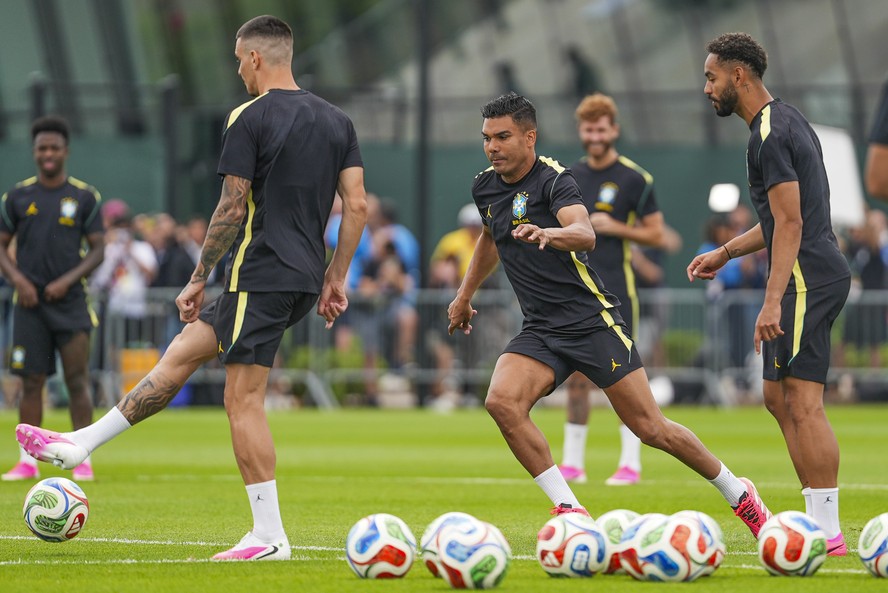
 Seleção treina antes do jogo contra o Haiti


Fernando Kallás


Eu não sei você, mas eu não estava preparado para cair na real que o Brasil desceu de escalão. Por mais que soubesse que o ciclo foi lamentável, que a seleção bateu recordes negativos, sofreu contra rivais mais fracos, se classificou aos trancos e barrancos e ainda por cima gastou uma valiosa vaga no elenco para levar um Neymar lesionado em uma decisão em que parece ter pesado mais a fé do que a tática, quando o Brasil aterrisou Mas se o primeiro tempo contra o Marrocos foi um toque de despertar, a entrevista coletiva do Danilo na quarta-feira foi um balde de água fria jogado na cara daqueles, como eu, que não quiseram acordar mesmo depois de todos os sinais.

Danilo é muito lúcido falando, mas eu não sei se estou preparado para essa lucidez se o papo é seleção brasileira. Porque dói, cara. É muito difícil reconhecer o estado em que a seleção se encontra, principalmente quando a explicação quem dá é um dos líderes do time que reconhece, sem titubear, que o Brasil, hoje, está um nível abaixo da concorrência.

“Temos que ser claros: nós não temos a maturidade que uma equipe como a França ou a própria Argentina tem hoje,” Danilo disse. E, para piorar, ele reconheceu que o Brasil não tem, hoje, a capacidade de jogar de igual pra igual como as principais seleções dessa Copa: “As nossas ferramentas têm que ser diferentes... Talvez ficar um pouco mais baixo, talvez não pressionar tanto, talvez aceitar em algum momento que a posse de bola e o comando do jogo possam ser do adversário...”

Longe de mim querer filosofar sobre preferir perder jogando como time grande a ganhar como time pequeno, mas não deixa de ser chocante ouvir do líder da seleção brasileira que a camisa mais pesada do mundo, a do jogo bonito, de Pelé, Garrincha e Ronaldo, já não tem o mesmo pedigree. Que o Brasil perdeu hierarquia como seleção e que precisa pensar seriamente em jogar na retranca, no contra-ataque, para poder ter uma chance de conseguir ganhar o hexa esse ano.

Hoje o Brasil enfrenta o Haiti com a obrigação de reconhecer suas limitações e não utilizar esse jogo contra um rival teoricamente fraco para tentar mascarar as fraquezas. Porque o resultado de hoje provavelmente não importa muito. Mas me preocupa quando ouço o Ancelotti dizer que “a Copa não se ganha no primeiro jogo” e que “a estreia não irá determinar o resultado final da Copa”.

A Espanha em 2010 e a Argentina em 2022 são exemplos de como importa, e muito, aprender com um toque de atenção na estreia da Copa. Sempre e quando se tem a lucidez, ou, como o Danilo repetiu várias vezes, a maturidade de entender que o começo condiciona o caminho que você percorre. Até porque não existe uma regra de como lidar com a derrota.

Vicente del Bosque quase não mexeu no time que perdeu para a Suíça na estreia da África do Sul. Já Lionel Scaloni fez cinco mudanças depois de perder para a Arábia Saudita. Ancelotti precisa encontrar o seu caminho. E o primeiro passo é hoje contra o Haiti.em Nova Jersey eu fui tomado por aquele otimismo inocente, aquela febre de Copa que é gostoso sentir e que faz parte da identidade como brasileiros. Que a camisa canarinho mete medo antes mesmo de a bola rolar e que não existe outro resultado aceitável para o Brasil em uma Copa do que o título.

O italiano já sabia que teria pela frente um dos rivais mais difíceis, senão o mais difícil que qualquer cabeça de chave poderia enfrentar. E, para piorar, na estreia.

O técnico da Espanha, por exemplo, já falou claramente que pode poupar vários titulares, inclusive a grande estrela Lamine Yamal, na estreia contra o fraco Cabo Verde. Não duvido que a Argentina, cheia de jogadores cansados e lesionados, também pegue leve na estreia contra a Argélia. Portugal pega a RD Congo; Alemanha, Curaçao.

Já Ancelotti pega a grande surpresa da última Copa, o time que eliminou Portugal e Espanha antes de perder para a França na semifinal, e que venceu o Brasil em uma noite que, para eles, foi memorável. E para nós, quase humilhante.

Foram dias estranhos aqueles que vivi de perto em Rabat, em março de 2023, acompanhando a seleção antes da derrota por 2 a 1 para o time da casa. Quando aquele amistoso foi anunciado, lembro muito bem as conversas com colegas jornalistas que também cobrem a seleção, todos meio sem entender muito bem por que a CBF tinha se metido naquela que parecia uma tremenda roubada.

Tite tinha deixado o comando, e o Brasil não tinha técnico. Cruzar o Atlântico com o treinador da seleção olímpica para ser o arroz da festa do Marrocos, no que seria o primeiro jogo deles na frente da torcida depois da campanha histórica no Catar, era algo meio surreal.

E tinha a tensão adicional do então presidente Ednaldo Rodrigues estar disposto a tentar persuadir Ancelotti a deixar o Real Madrid para assumir a seleção. Eu, inclusive, não fui ao Marrocos para cobrir o jogo. Minha única intenção, como repórter da Reuters, era convencer Ednaldo a falar sobre isso pela primeira vez diante de uma câmera. E consegui a exclusiva que caiu como uma bomba na Europa. Era o presidente da Confederação Brasileira de Futebol reconhecendo pública e abertamente que queria um treinador estrangeiro que tinha contrato vigente com o maior clube do mundo... Era o começo de uma novela que primeiro parecia impossível, foi ridicularizada e, dois longos anos depois, acabou se concretizando, mas às custas de um abandono da seleção brasileira que pode ter consequências na busca pelo hexa nos EUA.

E o primeiro capítulo do que foi o pior ciclo de Copa daquela que, um dia, foi a maior e mais respeitada seleção do planeta começou lá em Rabat. Foi uma noite mágica para o time da casa e para os torcedores locais, porque coincidiu com o fim do mês sagrado do Ramadã, o chamado na fé muçulmana de Eid al-Fitr, quando os fiéis terminam o período de jejum e penitência com júbilo. A partida foi posta num horário acorde com a celebração. Foi lindo de ver como observador, mas estava na cara que era uma cilada a que o Brasil foi irresponsavelmente exposto.

Graças a derrotas como aquela, a seleção foi perdendo uma das coisas mais difíceis de recuperar no futebol: a hierarquia. Aquele respeito, receio que os rivais sempre tiveram quando viam do outro lado a mística camisa amarela.

Vini Jr., Casemiro, Paquetá e Ibañez estavam em campo naquela derrota e, amanhã, terão a oportunidade de recuperar, dentro de campo, essa hierarquia, esse respeito. E mostrar que nada disso está perdido, que o Brasil é apenas um gigante adormecido. 

O GLOBO