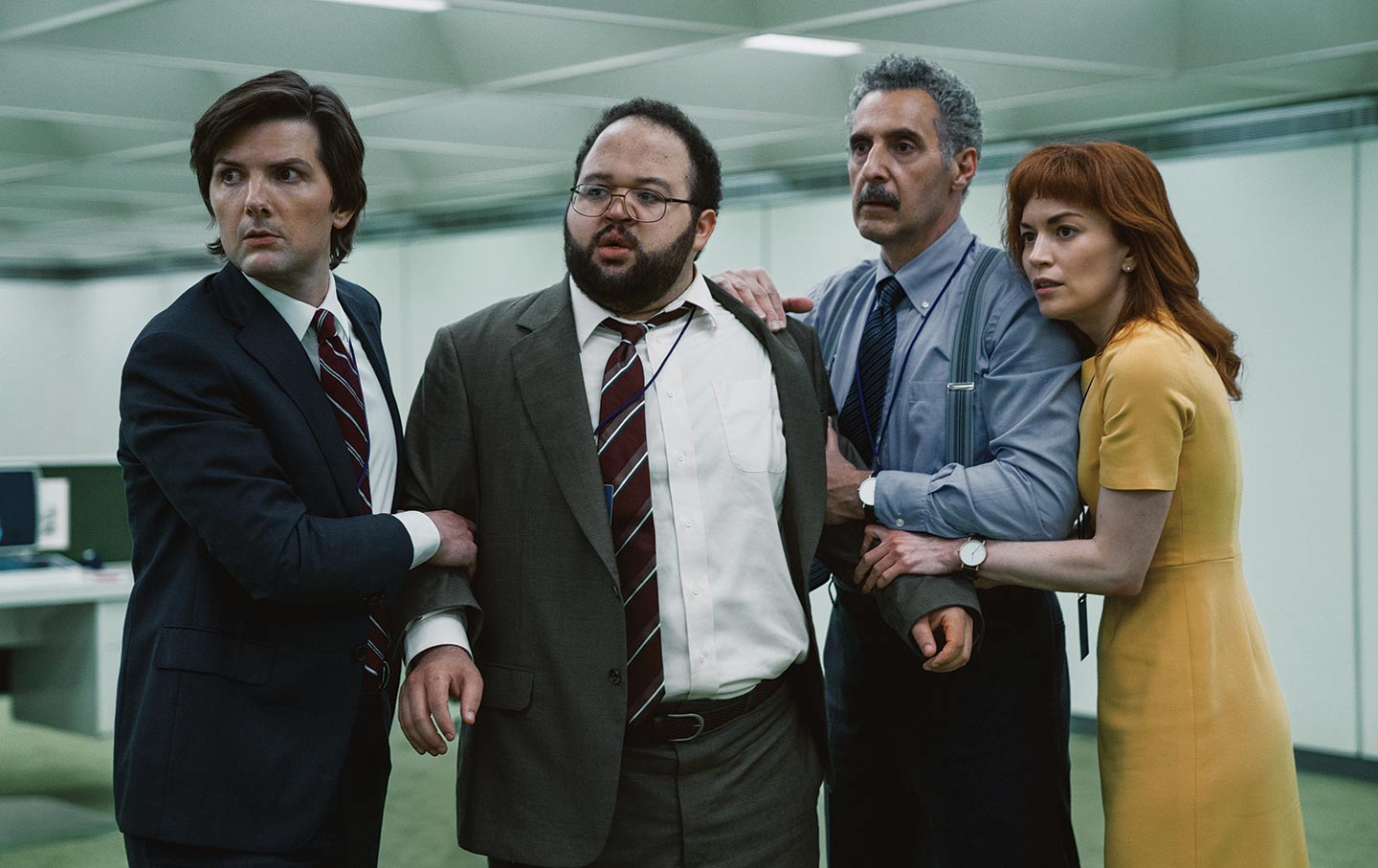
In the waning decades of the 20th century, the American labor force experienced myriad, well-documented changes that systematically disempowered workers across all economic sectors. Long-standing unions were either busted or saw their membership radically decline; wages stagnated even as the GDP grew at a steady clip; and politicians waged successful campaigns to cut taxes on capital gains. Income and wealth inequality skyrocketed, and higher profits emboldened employers to exploit workers even further. If workers had became alienated from the products of their labor during the Industrial Revolution, by the dawn of the 21st century they had became psychologically alienated from the labor itself, as its only ostensible purpose is self-perpetuation.
“Living to work” instead of “working to live” became the modus operandi for many, especially after upward mobility had long since ceased to be an achievable goal. Now not only is an American what they do, but their place of work is a “home,” even as it provides them with fewer protections and asks more of their time. “When you’re here, you’re family,” preached the famously cheesy Olive Garden slogan, but it chillingly doubles as the motto for the American workplace.
The premiere of the Apple TV+ series Severance benefits from good cultural timing, as many people have started to reevaluate their attitudes toward work and the workplace in the wake of Covid-19. There’s now a premium, however small it may be, placed on decoupling job satisfaction from one’s overall well-being. Fittingly, the premise of Severance asks: What if you could medically guarantee that you will never take your work home with you? In the series, one of the world’s largest corporations uses a surgical procedure to separate their employees’ work and nonwork memories, essentially splitting them into a work self (an “innie”), who “wakes up” every time they enter the office, and a personal self (an “outie”).
The series’ protagonist, Mark Scout (Adam Scott), works for Lumon Industries in the Macrodata Refinement division, having undergone the severance procedure after his wife died in a car crash. Severance opens with Mark trying to ease a newly severed coworker, Helly (Britt Lower), into the workplace after she wakes up on a conference table with no idea who or where she is. She’s set to replace Petey (Yul Vazquez), Mark’s best friend at the company, who was fired under mysterious circumstances; we quickly learn that Petey’s work and personal memories have been “reintegrated” via a controversial backroom procedure. A disheveled Petey eventually gets in touch with outie-Mark to inform him that Lumon, naturally and obviously, is not what it seems.
Created by Dan Erickson, and with Ben Stiller as executive producer, Severance uses its high-concept, Twilight Zone–like premise to explore dystopian corporate overreach. The series necessarily demands an immersive world rife with mysteries, and thus Erickson and Stiller have molded it to be artificial and stuck out of time, like Hell designed in the image of a Big Tech company. In fact, while Severance has been acclaimed for its “puzzle box” plotting—i.e., opening various narrative cans of worms to retain viewership—it is first and foremost a feat of production design. The interior of the Lumon offices eerily, effectively resembles what a prison would look like if an architect had designed it to evoke a mid-20th-century office building.
The warm yet ominous look of Lumon goes a long way toward lending credence to the Macrodata Refinement division’s revolt against its corporate overlords, who include the protagonists’ immediate supervisor, Seth Milchick (Tramell Tillman), and acting boss, Harmony Cobel (Patricia Arquette). Over the course of Severance’s debut season, Mark, Helly, and their fellow workers—the profane, smugly content Dylan (Zach Cherry) and the fastidious rule-follower Irving (John Turturro)—wake up to their employer’s nefariousness and reject the severance procedure. After this, they begin to feel the walls of their ostensibly safe workplace closing in on them. Though the series often bites off more than it can chew, Severance succeeds when it squarely focuses on Mark and his coworkers’ slow radicalization. Like many labor activists of yore, they’re spurred to take down the system by a piece of literature. Only it’s not The Communist Manifesto that wakes them up but, rather, in one of the best jokes of the year, a pretentious self-help book, the kind whose cover would make your eyes glaze over in a bookstore.
espite Stiller’s involvement, which includes directing two-thirds of the season’s episodes, Severance isn’t a comedy, at least not in the traditional setup-and-punchline sense. Minor bouts of surrealism occasionally puncture the series’ sober tone, but it still retains a serious disposition appropriate to the disturbing nature of the premise. Yet this doesn’t mean the show is humorless. A lot of Severance’s best elements could be described as structural or even architectural comedy: Dark gags involving design and philosophy comprise the show’s foundation, which underscores the emotional substance of the characters who tread its ground.
Case in point: Mark’s pompous, touchy-feely brother-in-law, Ricken Hale (Michael Chernus), whom both Mark and his sister Devon (Jen Tullock) regard with eye-rolling acceptance, gives a copy of his new book, The You You Are, to outie-Mark. Before he can read it, it’s confiscated by Cobel, who poses as Mark’s well-meaning next-door neighbor to keep an eye on him outside of work. She brings it into their shared office space, where innie-Mark unexpectedly finds it and then hides it from his bosses. He and Dylan secretly read it in their spare time and start to absorb its corny if well-intended maxims. In one episode, we hear a string of excerpts: “A society with festering workers cannot flourish, just as a man with rotting toes cannot skip.” “What separates man from machine is that machines cannot think for themselves. Also, they are made of metal, whereas man is made of skin.” “Bullies are nothing but Bull and Lies.”
The You You Are’s laughable prose would be roundly mocked by outie-Mark, but innie-Mark and his compatriots find genuine inspiration in a book that preaches worker liberation, however clumsily, through New Age vernacular. Severance underscores this gag by implicitly contrasting it with the teachings of Lumon’s founder, Kier Eagan (Marc Geller), who dispenses his cult-like, conformist rhetoric via a workers’ handbook that doubles as a bible. The series thankfully doesn’t hang a lampshade on the contrast, but the joke is that Eagan’s proselytizing, while more refined and better written than Hale’s, is infinitely more insidious. In one episode, Irving recites two quotes from the handbook: “Be content in my words and dally not in the scholastic pursuits of lesser men” and “No workplace shall be repurposed for slumber,” which translate to “Don’t listen to outsiders” and “Never nap at work.”
Severance’s most effective bit, however, is the labyrinthine design of the Lumon building itself, specifically intended to confuse and trap the workers within. Mark and his colleagues spend most of their time in the Macrodata Refinement section—a massive low-ceilinged room whose sterile atmosphere uneasily clashes with its homey decor and kitschy, anachronistic technology—but their floor is made up of endless, identical white hallways that seemingly lead everywhere and nowhere. Lumon forbids them to map the office, and though they are aware of the existence of other departments, it’s unclear how many or exactly where they are. As director, Stiller pulls off a neat trick in a late episode when he briefly tracks Mark and Milchick down a hallway, but as the two take a right, the camera moves left. The white wall fills the entirety of the screen for a brief second, until Milchick enters from the right. Stiller’s camera, still tracking left, eventually catches up with Mark, but the disorienting effect speaks volumes: Even we don’t know in which direction they’re going.
Severance literalizes many similar Dilbert-esque jokes about office culture. It’s impossible to leave the building before quitting time. The “break room” is a torture site. The work that Mark and his colleagues do is comically meaningless—dragging and dropping random sets of numbers on a computer screen—which is fitting because “Macrodata Refinement” is so vague as to mean nothing. The team ostensibly works for depressingly banal perks: finger traps, dance breaks, crystal cubes, egg and melon bars, a “waffle party” that’s also a burlesque show. They’re cheap distractions to stop Mark and the others from asking what many white-collar workers have asked in their own lives: What exactly do we do here?
ollowing in a long line of conspiracy-driven shows, Severance asks more questions than it answers, teasing clues about Lumon’s influence and its toxic objectives. It’s somewhat impressive how much runway Erickson gives himself for future seasons. For example, the series has only started to touch on how the severance procedure impacts the outside world. Mark lives in a Lumon-subsidized town that’s clearly being surveilled, and the company’s political influence, which extends to state senators who want to combat public distaste for the procedure, has yet to be explored. Mysterious figures, like an unseen “board” that communicates approval or displeasure through a surrogate, remain unexplained. Late-season twists indicate that Lumon has been hiding considerable collateral damage from the public. We don’t even yet know how many other floors, departments, or workers lie within the company’s building.
This caginess can be frustrating, in the sense that it’s a toss-up whether the answers to these questions will ever satisfy. It’s tempting to read this type of opaque plotting as protracted wheel spinning, and in its worst moments and digressions Severance does feel like it’s stalling for time. But as is the case with most television in this vein, the journey tends to be more rewarding than the destination. In the beginning, the series was compelling because it withheld basic information about its very premise, and when viewers were finally provided with enough to feel grounded, its direction and performances became the draw—at least save for Arquette’s, whose acting choices slowly grate more and more over the course of the season. Severance doesn’t reinvent the wheel narratively—there are the expected reveals and twists that arrive at their prescribed moments—but it follows through on familiar motions with enough energy to qualify as lively.
The glaring issue with the series is not its lack of answers or specificity but rather the more existential query: why any corporation would offer the severance procedure in the first place. Severance more or less asks viewers to take it on faith that Mark’s decision to sever his memories as a byproduct of grief passes muster despite its shaky emotional reasoning. (Would any halfway intelligent person agree to accept the incoherence of self so that they would only experience sorrow half the time?) A similar leap is asked of the viewers when it comes to his co-workers, whose decisions to sever are only hinted at but appear to be similarly trauma-motivated. Even from the perspective of the most hyperbolically evil corporation, the benefits of having complete control over its employees hardly outweighs the enormous liability of dissent catalyzed by anyone asking any questions about the company or pushing back on the merits of severance. Lumon resorts to psychological torture and a covert surveillance operation to keep its workers in line, and yet for that very reason it prompts suicide attempts and outright disorder. From a credibility standpoint, the company’s medical intervention just doesn’t seem like the safest bet when there’s such a high likelihood of anarchy.
Granted, crying foul with regard to plausibility in fiction, especially when it comes to the shortsightedness of corporate entities, might be foolhardy. But if the series wants to tackle the exploitation of labor, even in its own exaggerated way, it usually helps when the authoritarians’ methods of oppression make sense—logically and emotionally. Severance can have its characters ask “What are we doing?” and “Why are we here?” all it wants. It would be better for the show to ask itself, “Why do I exist?”
Jack
Nicas and André Spigariol, correspondents in Brazil, spoke to more than
35 judges, generals, diplomats and government officials to understand
the risk to Brazil’s election.
BRASÍLIA
— A simple but alarming question is dominating political discourse in
Brazil with just six weeks left until national elections: Will President
Jair Bolsonaro accept the results?
For months, Mr. Bolsonaro has attacked Brazil’s electronic voting machines
as rife with fraud — despite virtually no evidence — and Brazil’s
election officials as aligned against him. He has suggested that he
would dispute any loss unless changes are made in election procedures.
He has enlisted Brazil’s military in his battle. And he has told his tens of millions of supporters to prepare for a fight.
With its vote on Oct. 2, Brazil is now at the forefront of the growing global threats to democracy,
fueled by populist leaders, extremism, highly polarized electorates and
internet disinformation. The world’s fourth-largest democracy is
bracing for the possibility of its president refusing to step down
because of fraud allegations that could be difficult to disprove.
Yet,
according to interviews with more than 35 Bolsonaro administration
officials, military generals, federal judges, election authorities,
members of Congress and foreign diplomats, the people in power in Brazil
feel confident that while Mr. Bolsonaro could dispute the election’s
results, he lacks the institutional support to stage a successful coup.
Brazil’s last coup, in 1964, led to a brutal 21-year military dictatorship.
“The middle class supported it. Business people supported it. The press
supported it. And the U.S. supported it,” said Luís Roberto Barroso, a
Supreme Court justice and Brazil’s former elections chief. “Well, none
of these players support a coup now.”
Image
People preparing for a motorcycle ride in Salvador, Brazil, held in support of Mr. Bolsonaro. Credit...Victor Moriyama for The New York Times
Instead,
the officials worry about lasting damage to Brazil’s democratic
institutions — polls show a fifth of the country has lost faith in the
election systems — and about violence in the streets. Mr. Bolsonaro’s
claims of fraud and potential refusal to accept a loss echo those of his
ally Donald J. Trump, and Brazilian officials repeatedly cited the Jan.
6, 2021, attack on the U.S. Capitol as an example of what could happen.
“How do we have any control over this?” Flávio Bolsonaro, a senator and Mr. Bolsonaro’s son, said in an interview with the Brazilian newspaper Estadão
in reference to potential violence. In the United States, he said,
“people followed the problems in the electoral system, were outraged and
did what they did. There was no command from President Trump, and there
will be no command from President Bolsonaro.”
This month, more than one million Brazilians, including former presidents, top academics, lawyers and pop stars, signed a letter defending the country’s voting systems. Brazil’s top business groups also released a similar letter.
On
Tuesday, at an event with nearly every major Brazilian political figure
present, another Supreme Court justice, Alexandre de Moraes, took
office as the nation’s new elections chief and warned that he would
punish attacks on the electoral process.
“Freedom
of expression is not freedom to destroy democracy, to destroy
institutions,” he said. His reaction, he added, “will be swift, firm and
relentless.”
The crowd stood and applauded. Mr. Bolsonaro sat and scowled.
Mr.
Bolsonaro, whose representatives declined requests for an interview,
has said that he is trying to protect Brazil’s democracy by
strengthening its voting systems.
Among
the officials interviewed, there was broad disagreement over whether
the right-wing president was driven by genuine concern about fraud or
just fear of losing. Mr. Bolsonaro has consistently trailed former
President Luiz Inácio Lula da Silva, a leftist, in opinion surveys; if
no one wins a majority of the vote on Oct. 2, a runoff is scheduled for
Oct. 30.
Image
Mr. Bolsonaro trails the former president Luiz Inácio Lula da Silva in the polls.Credit...Dado Galdieri for The New York Times
Yet there are increasing hopes for a smooth transition of power if Mr. Bolsonaro loses — because he now appears open to a truce.
His
allies, including top officials in the armed forces, are about to begin
negotiations with Mr. de Moraes about changes to Brazil’s election
system designed to address the president’s security critiques, according
to three federal judges and one senior administration official close to
the planned talks, who spoke on the condition of anonymity because they
are confidential.
The
idea is that Mr. Bolsonaro would back off his attacks on the voting
machines, these people said, if election officials agreed to some
changes requested by Brazil’s military.
“I
have full confidence in Brazil’s election system. That also doesn’t
mean it’s infallible,” said Ciro Nogueira, Mr. Bolsonaro’s chief of
staff. “I’m sure, as the president says, the people will have their
say.” And on Saturday, Mr. Bolsonaro seemed to suggest at a rally that
he would accept the results of the election.
Yet
Mr. Bolsonaro has made similar comments in the past and agreed to a
similar truce last year — and then continued his attacks.
Those
attacks have had an effect. Since June, Brazilian Twitter users have
mentioned Brazil’s voting machines more than inflation or social-welfare
programs in relation to the election, and roughly as much as gas
prices, which have been a major point of political debate, according to
an analysis by researchers at the Getúlio Vargas Foundation
Communications School requested by The New York Times.
Image
Supporters of Mr. Bolsonaro in Salvador, Brazil.Credit...Victor Moriyama for The New York Times
A poll last month showed that 32 percent of Brazilians trusted the voting machines “a little” and 20 percent did not trust them at all.
At
the same time that many of Mr. Bolsonaro’s supporters are convinced
that the vote can be rigged, many more also have guns. Mr. Bolsonaro
made it much easier for civilians to purchase firearms under looser
restrictions for hunters, and now more than 670,000 Brazilians own guns
under such rules, 10 times as many as five years ago.
Inside his administration, Mr. Bolsonaro has been increasingly pulled between two factions.
One
side has encouraged the president to stop attacking the voting machines
because they believe the issue is unpopular with the more moderate
voters he needs to win over and because Brazil’s economy is rebounding,
helping his chances of re-election, according to two senior advisers to
the president.
They said the other
group, led by former military generals, has fed the president
misinformation and urged him to keep warning of potential fraud.
Election
officials last year invited the military to join a committee to improve
the election systems. The military suggested a series of changes, but
election officials said they could not be implemented in time for
October’s vote.
But military leaders
are still pushing for one specific change: for the voting machines’
integrity tests to happen with real voters, instead of in simulations.
Image
For months, Mr. Bolsonaro has attacked Brazil’s election officials as aligned against him. Credit...Victor Moriyama for The New York Times
The
military is concerned that a hacker could implant malicious software in
the voting machines that would recognize simulations and stay dormant
during such tests, allowing it to evade detection.
An election-security expert said such a hack is conceivable but unlikely.
Mr.
de Moraes, the new elections chief, has signaled that he would be open
to changes in the voting systems, though what might be achievable by
Oct. 2 is unclear.
Mr. Bolsonaro has
long been at odds with Mr. de Moraes, who has led investigations into
allegations of disinformation and leaks of classified material that
implicate the president and his allies. Mr. Bolsonaro has criticized Mr.
de Moraes as politically motivated, and said at a rally last year that
he would no longer abide by his rulings, a statement he later walked
back.
So Mr. de Moraes’s ascent to lead Brazil’s electoral court was expected to further aggravate tensions.
But
in recent weeks, he and Mr. Bolsonaro have begun chatting on WhatsApp
in an effort to mend their relationship, according to a person close to
the president. When Mr. de Moraes hand-delivered an invitation to his
inauguration as elections chief this month, Mr. Bolsonaro gave him a
jersey for Corinthians, Mr. de Moraes’s favorite soccer team.
(Corinthians is the archrival of Mr. Bolsonaro’s favorite squad,
Palmeiras.)
With tensions running
high, Brazil’s leadership decided to make Mr. de Moraes’s inauguration
on Tuesday — usually a procedural event — a demonstration of the
strength of the Brazilian democracy.
Image
Motorcycle caravans have become common at events in support of the president across the country.Credit...Victor Moriyama for The New York Times
In
a modernist, underground amphitheater, the heads of the Brazilian
Congress, Supreme Court and military joined five of Brazil’s six living
presidents for the ceremony, including Mr. Bolsonaro and Mr. Lula da
Silva.
Cameras
zoomed in on Mr. Bolsonaro next to Mr. de Moraes at the head table, a
rare sight. They whispered to one another, sometimes chuckling,
throughout the event. Then Mr. de Moraes got up for his speech. Before
the event, he had warned Mr. Bolsonaro that he wouldn’t enjoy it,
according to a person close to the president.
“We
are the only democracy in the world that calculates and publishes
election results on the same day, with agility, security, competence and
transparency,” he said. “Democracy is not an easy, exact or predictable
path. But it’s the only path.”
The room gave him a 40-second standing ovation. Mr. Bolsonaro was among the first to stop applauding.
Afterward, the two men posed for a photo. They did not smile.
As cassações do vereador negro Renato Freitas e do prefeito indígena Marcos Xucuru desnudam o revanchismo da casa-grande.
p or Fabíola Mendonça
Negro, periférico, advogado, mestre em Direito, vereador eleito em Curitiba em 2018 com 5.097 votos. Este é Renato Freitas, 38 anos, que carrega em sua biografia numerosos episódios de racismo e teve seu mandato cassado, no dia 5 de agosto, por ter participado, em fevereiro deste ano, de um protesto em frente à Igreja Nossa Senhora do Rosário dos Pretos, no Largo da Ordem, região central da capital paranaense.
O ato era para denunciar a xenofobia e o racismo que motivaram o assassinato do congolês Moïse Kabagambe, no Rio de Janeiro, atividade que aconteceu simultaneamente em várias outras cidades brasileiras. Enquanto o protesto acontecia do lado de fora, dentro da igreja o padre Luiz Hass celebrava uma missa e, ao término da celebração, os manifestantes, inclusive Freitas, adentraram na igreja. Este foi o “crime” que tirou do vereador do PT o mandato que lhe foi consagrado pelas urnas. “Crime”, por sinal, bem mais brando que o praticado pelo deputado estadual por São Paulo, Fernando Cury, que apalpou os seios da colega Isa Penna no plenário da Assembleia Legislativa e não perdeu o mandato. Ou do deputado bolsonarista Daniel Silveira, autor de ameaças aos ministros do Supremo Tribunal Federal e incontáveis ataques à democracia, mas a Câmara faz vistas grossas.
Fazendo uma analogia com outros ca- sos recentes, a cassação de Freitas torna- -se algo ainda mais inusitado. Em maio passado, a Assembleia Legislativa de São Paulo cassou o então deputado Arthur do Val, o Mamãe Falei, depois do vazamen- to de áudios sexistas do parlamentar, afir- mando que as mulheres ucranianas, refu- giadas de guerra, “são fáceis porque são pobres”. Em junho do ano passado, o en- tão vereador Doutor Jairinho, do Rio de Janeiro, perdeu o mandato por envolvi- mento na morte do menino Henry Borel, de 4 anos. E o que dizer do também vere- ador carioca Gabriel Monteiro, acusado de estupro de vulnerável? A Comissão de Ética da Câmara pediu por unanimidade a cassação do parlamentar, mas a decisão depende de aprovação no plenário.
A rígida punição aplicada ao vereador de Curitiba vai contra o posicionamento oficial da Igreja Católica, suposta vítima do ato que teria sido liderado por Freitas. O padre Luiz Hass não só saiu em defesa do parlamentar como esteve presente na sessão de cassação e sentou na primeira fi- la ao lado do réu. A Arquidiocese de Curi- tiba inicialmente registrou um boletim de ocorrência contra o protesto, mas, ao perceber a instrumentalização política do ato, voltou atrás. Durante a tramitação do processo, a entidade entregou ao Conselho de Ética da Câmara um documento colo- cando-se contra a cassação, considerando a punição desproporcional ao ocorrido e ainda elogiou o ativismo de Freitas contra o racismo e na defesa da população negra. “A manifestação contra o racismo é legíti- ma, fundamenta-se no Evangelho e sem- pre encontrará o respaldo da Igreja. Perce- be-se no vereador o anseio por justiça em favor daqueles que historicamente sofrem discriminação em nosso país. A causa é nobre e merece respeito”, diz um trecho do documento. O padre Júlio Lancellotti, re- conhecido pela defesa dos excluídos, tam- bém saiu em defesa de Freitas.
“Tecnicamente, nãohá objeto da cas- sação, porque não houve invasão da igreja. Canonicamente, não existiu a interrupção do ato litúrgico nem a profanação do espa- ço sagrado. Também não proferiram ne- nhuma palavra contra a fé nem houve de- predação”, diz Lancellotti, acrescentando que a cassação é fruto do racismo estrutu- ral. “A motivação é de ódio aos pobres e de um racismo que não suporta um vereador periférico questionar a hegemonia branca que manda em Curitiba. Não há razoabi- lidade. É uma cassação montada em cima defake news, ódio, racismo e aporofobia.”
O episódio teve grande repercussão no interior da Igreja Católica e chegou até o Vaticano. No fim de setembro, Freitas terá um encontro com o papa Francisco, quan- do deverá denunciar a cassação e o exter- mínio da juventude negra no Brasil. Há também a expectativa de o vereador ser recebido por organismos internacionais.
“Tentaram silenciar nossas vozes, nos as- fixiar e nos matar politicamente, porque ousamos fazer com que as pessoas soubes- sem que a mesma violência que ocorreu no assassinato do Moïse também ocorre em Curitiba”, acusa Freitas. Os advogados do vereador, Guilherme Gonçalves, Edson Abdala e Antônio Carlos de Almeida Cas- tro, o Kakay, entraram com uma ação na Justiça do Paraná, pedindo não só a devo- lução do mandato de Freitas, mas também a anulação da inelegibilidade de dez anos aprovada pela Câmara. O petista é candi- dato a deputado estadual.
Dentre os argumentosda defesa está o de que o processo não cumpriu o tempo estipulado pela legislação. Segundo os ad- vogados, a jurisprudência estabelece que o processo deveria ter ocorrido em, no má- ximo, 90 dias corridos. No regimento da Câmara, consta que esse prazo pode ser contado em dias úteis, o que para os advo- gados é inconstitucional. “A jurisprudên- cia entende que o prazo para fim de cas- sação de mandato dentro do Legislativo sempre é contado como decadência, em dias corridos”, explica Gonçalves. “Eles querem cassar o Renato desde o início. To- da instrução do processo deixa claro que a cassação se deu por racismo. Foi um jo- go de cartas marcadas”, completa Kakay.
O presidente da Câmara, vereador Tico Kuzma, defendeu o regimento interno e diz que a cassação por quebra de decoro é subjetiva. “É uma decisão de interpreta- ção de cada vereador, que, após analisar as provas, assim como o relatório do Conse- lho de Ética, define se o ato foi suficiente ou não para a quebra de decoro.” O parla- mentar nega o caráter racista do processo. Freitas não é o único que se diz ví- tima de racismo na política. Eleito em 2020 prefeito de Pesqueira, município do Agreste pernambucano, o cacique Mar- cos Xucuru jamais conseguiu assumir o cargo e, no início de agosto, o TSE confir- mou a inelegibilidade do indígena. Quem assumiu interinamente o cargo foi o pre- sidente da Câmara, Sebastião Leite da Sil- va Neto, que deverá repassar a função ao prefeito que será eleito em 30 de outubro.
Recai sobre Marquinhos, como é co- nhecido, a acusação de que ele teria es- timulado uma revolta popular em 2003, que resultou no incêndio de uma pro- priedade. Ele nem sequer estava presen- te no ato. O conflito foi gerado depois de uma emboscada contra o próprio caci- que, que resultou na morte de dois indí- genas. Marquinhos recebia atendimen- to médico durante a revolta popular, mas foi condenado por supostamente ter lide- rado o movimento. “Naquela época, cor- ria um boato de que o cacique também ti- nha sido morto e é nesse clima que a co- munidade xucuru vai incendiar a pro- priedade”, explica Eliene Amorim, pes- quisadora da causa indígena. O cacique foi condenado em duas instâncias e, em 2016, a sentença foi transitada em julga- do, cravando o nome de Marcos Xucuru na Lei da Ficha Limpa.
“A decisão do TSE reafirma as injusti- ças e a criminalização que os xucurus so- freram historicamente. Com base em jul- gamento que ocorreu há tanto tempo, os ministros impediram que a principal li- derança desse povo ocupasse a função de prefeito, legitimando o preconceito e o ra- cismo estrutural”, destaca Saulo Feitosa, estudioso dos povos xucuru, acrescentan- do que o conflito de 2003 se deu num con- texto de disputa pela terra e que os agres- sores não eram os indígenas. Marcos Xucuru se diz injustiçado tanto pela de- cisão do TSE quanto por ter sido conde- nado pelo conflito de 2003. “Por conta da luta pelo território ainda hoje estou sendo perseguido, tendo meus direitos políticos cassados por uma coisa que eu não cometi. Algumas pessoas não aceitam que os indí- genas possam ocupar espaços de poder.” A Articulação dos Povos Indígenas (Apib), em conjunto com a Articulação dos Povos e Organizações Indígenas do Nordeste, Minas Gerais e Espírito Santo (Apoinme), publicou uma nota em apoio a Marquinhos e contra a decisão do TSE.
Dentre os ministros da Corte eleitoral, o único que votou a favor do indígena foi Edson Fachin. O ministro observou que o caso está inserido “no âmbito de um com- plexo contexto de conflito étnico, no qual está em jogo não apenas o bem econômico nem somente o patrimônio das pessoas”.