Daniel Mendelsohn
Aristotle, for one, wasn’t all that impressed by Odysseus’s adventures. In the seventeenth chapter of his Poetics he observes, apropos of the relationship of a story’s “essential” meaning to its constituent episodes, that
the storyline of the Odyssey is not long. A man has been away from his homeland for many years, and Poseidon is always on the watch for him, and he is all alone. Meanwhile, the situation at home is such that his wealth is being consumed by the Suitors, who are plotting against his son. But after a storm-tossed journey he returns, and after revealing himself and attacking them is saved and destroys his enemies. That is the essential; everything else is episodes.
This summary will strike many as odd. Where, you wonder, are the famous adventures that most people think of as the meat of the great epic—the numerous escapades that showcase the ingenuity, wiliness, and derring-do of Homer’s hero during his decade-long return from the Trojan War? The Lotos-Eaters, who eat of a flower that erases memory? The seductive nymph Calypso, who holds him prisoner for seven years, offering to make him immortal if only he would stay with her—an offer he movingly refuses in favor of returning to his aging, mortal wife? His yearlong dalliance with the witchy Circe, who turns his men into swine? Or his lengthy sojourn among the effete Phaeacians, with their opulent wealth and glittering palaces, their taste for dancing and music—one of the many cultures that the epic presents as a tempting alternative to Ithaca—whose royal family the hero, deploying his famed rhetorical skills, wheedles into bringing him home?
Nor is there any mention here of the voyage to the Underworld, where, in one of the epic’s most moving moments, Odysseus attempts—and fails—to embrace the wispy ghost of his mother, of whose death, during his long absence, he had been unaware. And no mention either of the lengthiest of the adventures, the encounter with the one-eyed giant Cyclops, whom clever Odysseus—repeatedly celebrated by Homer as polymêtis (“greatly cunning”), polyphrôn (“having many kinds of intelligence”), polymêkhanos (“able to contrive many solutions”), and poikilomêtis (“of multifaceted wiles”)—vanquishes by means of an artful pun on the word “nobody,” the false name he gives the Cyclops when they first meet.
All this, in Aristotle’s summary, is reduced to “a storm-tossed journey.”
In part this is because he rightly emphasizes the importance of that other, far vaster part of the Odyssey, what he calls “the situation at home”—the crisis that the hero’s long absence has created for his city, whose political institutions are collapsing; for his wife, Penelope, who is besieged by the Suitors; and for his young son, Telemachus, who strives to live up to the grand reputation of the father he never knew. These constitute what screenwriting courses refer to as the “stakes”—the crisis that must be resolved by the hero’s eventual return; otherwise the homecoming has no point. Only four of the epic’s twenty-four books are devoted to the adventures, which are narrated by the notoriously smooth-talking hero himself before the mesmerized Phaeacian court: his greatest feat of verbal artistry.
But the main reason Aristotle gives short shrift to the adventures has to do with the epic’s structure. In the section of the Poetics devoted to the Odyssey, he’s primarily interested in the workings of plot. The Odyssey’s plot is one that he admires as being “complex” (the many ups and downs of its characters, the multiple scenes of recognition with which the poem concludes) and commends because of its “double thread”: the ascending arc of its hero’s rehabilitation and eventual triumph, twined around the descending arc of his enemies’ downfall.
While satisfying to Aristotle, the very complexity of the Odyssey’s narrative, constantly moving as it does between past and present, reminiscence and action, Ithaca and those far-flung voyages, is no doubt what has made it so difficult to bring successfully to the cinematic screen—this despite the fact that the adventures in particular seem to cry out for big-screen, special-effects treatment. The problem isn’t merely the vast amount of incident that needs to be covered. Homer also has a distinctive way of embedding his elaborate narratives within other narratives. Stories nest within stories; lengthy conversations are reported within other lengthy conversations. The most famous instance of this technique occurs in book 19, when an elderly housemaid who is bathing the feet of the disguised Odysseus recognizes a telltale scar that the hero had incurred during a boar hunt in his youth. At the moment she realizes that the “beggar” before her is her long-lost master, the narrative grinds to a halt in order to loop back through not one but two embedded flashbacks, first to the boar hunt and then to the day of the hero’s birth, before circling back to the present.
How to represent any of this—the structure and the technique as well as the vast tale itself—in the course of two or three hours?
One answer is that you can’t. It is no accident that the most scrupulously faithful dramatic adaptation of the Odyssey has been not a film but a miniseries: the meticulously detailed eight-part L’Odissea (1968), a French-Italian coproduction directed by Franco Rossi. The miniseries, a form that is itself episodic, solves the problem of how to weave many episodes into a larger pattern that is never extraneous to the “essential” theme of the story—Odysseus’s homecoming, its nature, origins, and ramifications—as Aristotle recommends. The great length permitted by the genre allowed the writers of the series to evoke even the most minor characters and incidents.1
But a movie—even a very long movie—inevitably has a much harder time twining the threads, organizing the episodes in a way that does not (and this is the trick) feel “episodic.” It says something that of the very few movie adaptations of the Odyssey that have appeared, two—Ulysses (1954), an antic and amusing Italian production starring a swashbuckling Kirk Douglas and Silvana Mangano as the royal couple and Anthony Quinn as Antinoüs, the loathsome leader of the Suitors, and, more recently, The Return (2024), with Ralph Fiennes and Juliette Binoche—make deep cuts. The former eliminates most of the adventures (presented as flashbacks while Odysseus gazes out to sea during his stay with the Phaeacians) while compressing the situation at home to a bare minimum.
The Return, on the other hand, cuts out the entire first half of the epic and starts with the hero’s return home. This naturally eliminates not only the supernatural elements—the gods, the nymphs, the monsters, the divine dalliances, and the spooky encounters—but everything in Homer that establishes the stakes. Informed, perhaps, by recent approaches to the Homeric poems as proto–case studies in PTSD,2 the film recasts what Aristotle saw as the hero’s triumphant arc as the grim tale of a traumatized veteran. (At one point Odysseus himself openly sneers at the idea of “heroes” when someone asks about the war.) The Ithaca to which this Odysseus, played by a wiry, scowling Fiennes, comes home reflects his depressed state: a scattering of dun-colored huts inhabited by meanly clothed peasants, its palace a dreary pile of stones. You wondered why he was so eager to get back.
To do all of the Odyssey justice—justice, that is, to its structure as well as its content—it would seem that you need a director who is not only capable of producing a visually engrossing spectacle but also adept at handling complexly embedded narratives. Which is why, soon after the release of The Return, some people, myself included, were elated when it was announced that the British American director Christopher Nolan was working on a movie adaptation of the epic.
Nolan, after all, made his name by twisting narrative threads in ways you wouldn’t be wrong in describing as polymêtis. His first feature, Following (1998), tracks an aimless young Londoner who likes to follow random people around—harmlessly at first—until one of them turns out to be a sly cat burglar who ensnares his stalker in a dense and finally deadly web of lies and illusions. Memento (2000), which won him widespread acclaim, highlighted what was to become another entrenched theme of the filmmaker’s work: the relationship between memory and guilt. An amnesiac (Guy Pearce) bent on finding and killing his wife’s murderer must rely on an elaborate system of photographs and notes, some tattooed on his own body, as a means of retaining consciousness of who people are, where he has been, and what he has accomplished in his quest for clues. Here, too, it turns out that the protagonist has been the victim of an ingeniously plotted scam.
What was so intriguing about Memento was the technique Nolan employed to suggest Leonard’s fragmented mental reality and to recreate it in the audience. The film has two narrative threads: a black-and-white sequence that follows events in chronological order and a color sequence that moves backward in time. As each proceeds, the audience comes ever closer to being able to put the pieces together in a way that Leonard can’t. Such toying with chronology has become a hallmark of Nolan’s work, not least in a marvelous venture into sci-fi, Interstellar (2014), an astronauts-saving-the-inhabitants-of-a-dying-Earth extravaganza in which time, literally bent out of shape (there’s a black hole), moves at different rates for various of its characters, with sometimes very moving results. I doubt that I was the only one in the theater getting teary-eyed during the scene at the end between the still-young protagonist (Matthew McConaughey) and his now elderly daughter.
Guilty characters with dark pasts resurfaced in other Nolan films, most notably the Dark Knight trilogy, the opening chapter of which, Batman Begins (2005), depicts Bruce Wayne/Batman (Christian Bale) as a man who, because of his failure, as a boy, to prevent the murder of his father and mother, feels no less “guilty” in some ways than are the outlandish villains he constantly battles. Nolan’s psychologically somber Batman films were ecstatically received as a shrewdly contemporary reimagining of the old franchise and had huge international success, but to my mind they lacked—perhaps of necessity, given their pop nature—the stimulating structural ingenuity of some of his other films. In The Prestige (2006), an obsessive and ultimately murderous rivalry between two turn-of-the-century London magicians—one of whom has caused the death of the other’s wife—results in deliciously inventive plots-within-plots that allow the director to play at length with favorite themes of guilt and innocence, illusion and reality, human action and its sometimes unforeseen consequences.
And in the Oscar-winning Oppenheimer (2023), another guilt-ridden hero (Cillian Murphy, playing the morally tormented leader of the Manhattan Project) is caught in knotty webs of both his own and others’ making. Here Nolan topped Aristotle by having not two but three discrete plot threads twining around one another: one follows Oppenheimer’s participation in the development of the atom bomb; the second looks forward to the Star Chamber–like 1954 government investigation of Oppenheimer, whose security clearance has been threatened by his early ties to the Communist Party; and the third, set in 1959, focuses on Senate hearings on Lewis Strauss’s nomination as commerce secretary and his involvement in revoking Oppenheimer’s clearance back in 1954.
Nolan’s penchant for convolution can lead him astray. I’ve never quite been able to figure out precisely what’s going on in Inception (2010), a stylish fantasy in which futuristic criminal “extractors” wreak high-tech havoc on their marks by stealing their inmost thoughts from—or implanting new thoughts in—their subconscious, a feat they manage to achieve by entering their victims’ dreams. (Or something.) Still, the rendering of the dreams was so visually arresting that I’m not sure I cared. And the director’s virtually nonverbal World War II epic Dunkirk (2017) left you understanding nothing about that historical disaster, but it was gratifyingly eye- (and ear-) popping.
Whatever its flaws, Nolan’s work indicated that he might indeed be the right person to take on Odysseus, another multifaceted hero characterized at once by admirable cleverness and dark behaviors, and the Odyssey, a text characterized by temporal disjuncts and narrative playfulness. The result, a $250 million, three-hour-long behemoth, the first movie to be shot entirely in the IMAX format, is, like Batman Begins, a darkly psychologizing updating of a classic; like Memento, it toys with themes of memory and forgetting while, like Oppenheimer, it twists a profusion of narrative and temporal arcs. And like the sack of unruly winds that Aeolus, the divine custodian of the winds, entrusts to Odysseus in book 10—only to have it opened by the hero’s suspicious crewmen, with disastrous results—it is in the end a mixed bag: at once a vehicle for the director’s virtues and, as with The Return, a case study of the weaknesses inherent in attempting to modernize a work many of whose values remain, for all its timelessness, stubbornly archaic.
It’s not that Nolan isn’t aware of the values of the original. In an interview that appeared in The New York Times a month before the movie’s release, he spoke about his early, formative love for the Odyssey, which he first encountered as a stage production he saw as a young schoolboy in London. What marked him particularly, he recalled, were the image of the Trojan Horse—the clever invention of Odysseus that allowed the Greeks to infiltrate Troy, which is mentioned several times in Homer’s text and is the subject of a song sung by the Phaeacians’ court bard—and the episode of the Sirens and their song.3
Small wonder, then, that the film, in all its IMAX glory, is often visually impressive and, even more interestingly, that from its opening to its closing scene it finds ways to remind us that epic was considered to be a form of “song” and hence was something its original audience experienced aurally rather than visually. It’s a nice touch that Nolan’s film begins with Phemius, the court bard in Odysseus’s palace, rapping rhythmically on the floor with his stick as he intones words with well-known connections to the tales of Troy—“a face [i.e., Helen’s], a man, a song”—and, even more, that Phemius is played by the rapper Travis Scott: the director’s sly nod to the oral, improvisational origins of Archaic epic.
As you’d expect, Nolan’s own “song” effectively replicates the imbricated textures of the original. Because of the nature of epic narration, with its vast arcs, many famous “reveals” necessarily stand cheek by jowl with the backstories that set them up. When, in book 17, Odysseus approaches the gate of his palace for the first time in twenty years and spots his faithful old hunting dog, Argos, now flea-bitten and lying atop the town dung heap—a powerful analogue for the haggard warrior himself—the poet pauses to give you the story of how Odysseus acquired and trained Argos as a puppy, what good a tracker he was, and so forth. Similarly, there’s a climactic moment at the end of book 21 when Odysseus finally reveals his true identity by wielding a magnificent bow that he alone is strong enough to string—he plucks its twanging string, Homer tells us meaningfully, just the way a professional bard does with his lyre—and by shooting an arrow through twelve ax heads that have been lined up: a trick, the poet has recently told us, that he used to perform in the bygone days.
Nolan inserts space between the backstories and the reveals in a way that’s appropriate to a dramatization and finds ways to give the tension between past and present interesting visual textures. Early on, an image of the now decrepit Argos, abused by the arrogant Suitors (led by Robert Pattinson’s sneering Antinoüs, in a faded-pretty-boy turn), melts into a flashback of the young hero meeting his frisky puppy; a bit later we’re watching a younger Odysseus (a heavily bearded Matt Damon) performing his arrows-through-the-axes trick as Penelope, smiling indulgently, looks on. And Nolan has found ways to slip the twanging of the bowstring early enough into his movie that when the returned hero plucks the bowstring at the end—the prelude to the climactic slaughter of the Suitors—the moment has just the right shivery power. Since Nolan started dropping trailers, the Internet has been aflame with discussions of the “accuracy” of the costumes, ships, armor, and diction of the movie, but the most authentic thing about this Odyssey may well be its densely braided narrative textures, which succeed in replicating Homer’s artful weaving.
Weaving, as it happens, is crucial in the Odyssey. Even people who have never read the epic are likely to have heard the story, recalled by an irritated Suitor in book 2, of how “sharp-witted” Penelope, every inch as ingenious as her husband, had held off the Suitors for three years by promising that she’d marry one of them when she finished weaving a funeral shroud for her father-in-law, Laërtes—and then, by night, unweaving what she’d woven by day. Nolan places this scene in the “now” of the homecoming story: Penelope (Anne Hathaway, in a portrayal that wavers nicely between sharp authority and anguish) explains her weaving process to Telemachus and then, gesturing to the palace and the city beyond, as if her civilization itself were a giant artwork, makes an observation about the relationship between form and content of which Aristotle himself, you suspect, would approve: “The structure is nothing without the people’s respect for its meaning.” Like the sly self-reflexive depictions of bardic artistry in the Odyssey, the queen’s remark seems like a comment on the way Nolan’s elaborately textured structures are meant to serve his long-standing themes.
While Aristotle gives the adventures short shrift, Nolan certainly doesn’t; the movie has great visual panache. In the Underworld scene, the hands of the dead, whom Odysseus has been instructed to summon by means of a creepily bloody ritual, wriggle upward, unnervingly, from beneath the black sand of the shore. The storms at sea—scenes to which Homer devotes some of his most memorably descriptive poetry—are impressively scary. And Nolan’s rendering of the Cyclops episode is unlikely to be topped, the huge IMAX screen powerfully conveying the inky immensity of the giant’s lair as the Greek warriors, puny in comparison with their tormentor, anxiously wander through it. (All this is helped by some very effective sound design: the entire theater shakes when Polyphemus makes his entrance.) In this version, it’s not just the Cyclops’s (Bill Irwin’s) vision that’s wonky: some of his features have been violently twisted ninety degrees, so the famous “one sole eye” sits vertically in his forehead, blinking side to side.
Polyphemus isn’t the only character who gets a makeover. In Homer, Circe decorously taps Odysseus’s men with a magic wand to transform them into swine; Nolan gives the scene a repellent physicality, as the witch (a decidedly unglamorous middle-aged Wiccan type, played with earthy relish by Samantha Morton) violently uses her hands to massage their faces into snouts after they pig out on the stew she’s served them. In one of a few feminism-inflected moments, Circe bitterly suggests that the transformation reveals rather than conceals who these men really are: “They raped and pillaged across the world for you! Filthy soldiers with empty bellies and hot blood. Look at them and know your own men!”
It has to be said that whatever Nolan’s taste for optical extravagance, the production design here is disappointingly unimaginative: the drearily sepia-toned sets and costumes, sooty in the flickering torchlight, look like they’ve been rented from the Game of Thrones warehouse. In Homer, the palace of Odysseus’s old comrade Menelaos is so opulent that Telemachus, who’s come to interview the indulgent, rather sentimental Spartan king about his father’s whereabouts, openly gawks: “Look at the bronze that flashes throughout the echoing palace,/At the gleam of gold and amber—Look! Silver and ivory, too!” Here Menelaos is a thuggish warlord who, it would seem, has enjoyed beating his wife, Helen—the Kenyan Mexican actress Lupita Nyong’o, in a bit of casting that launched a thousand tweets—half of whose legendarily beautiful face is covered with deep scars. This Menelaos (Jon Bernthal, sounding vaguely Tony Soprano–ish) guffaws that perhaps that famous face would now launch only five hundred ships.
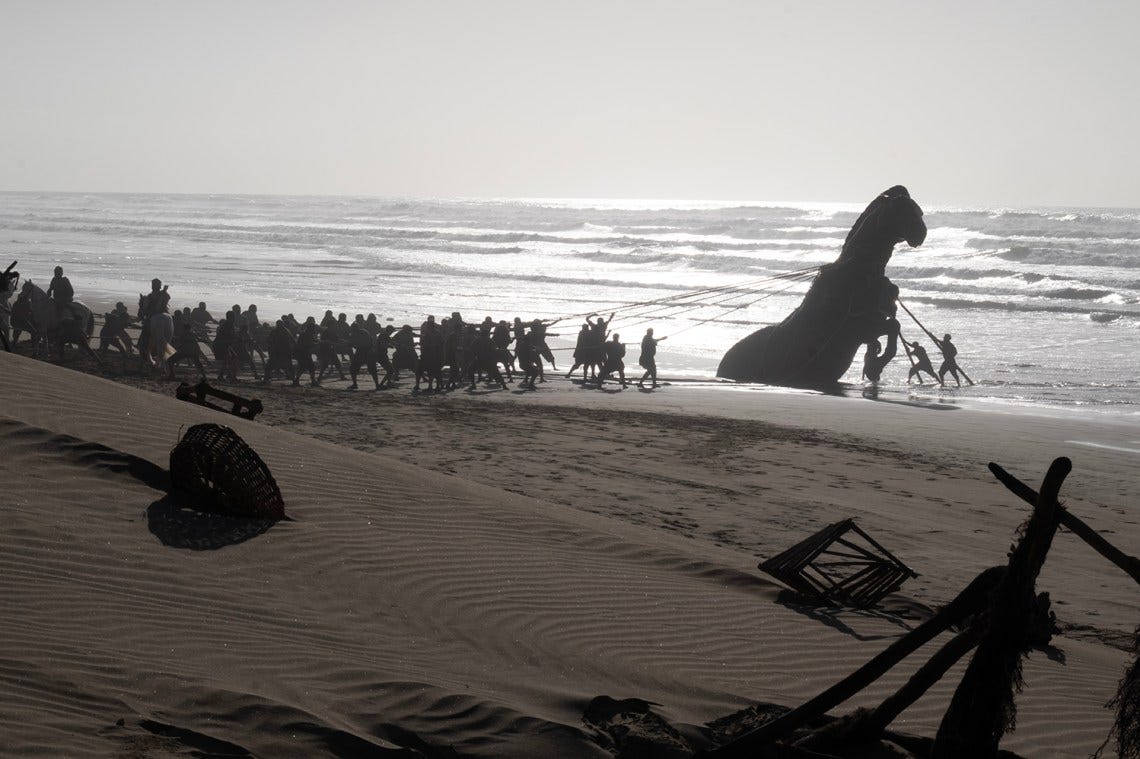
If the film has a single unifying visual motif, it is, unsurprisingly, the Trojan Horse, which made such an impression on the young Nolan. When we first see it, in an opening flashback to the end of the war, the huge black contraption is sticking out of the sand by the seashore, left there to be discovered by a group of gullible Trojan warriors. Odysseus has also left a young Greek soldier named Sinon (Elliot Page) to ensnare the enemy by claiming that it is a gift from the (allegedly) retreating Greeks. The Trojans seize the Horse and kill the naive youth, whom Odysseus had kept in the dark about the Greeks’ master plan. In Nolan’s Odyssey, the only significant encounter the hero has in the Underworld is with the ghost of Sinon, who reproaches his commander for his duplicity—the negative side of his great cunning. The final image of the film reiterates the point: the Horse’s unseeing eye, recalling that of the Cyclops, staring out from the smoking rubble of Troy—the deadly aftermath of yet another of Odysseus’s clever schemes.
But then, the only side of Odysseus—and indeed of the Odyssey—that you get in Nolan’s film is the negative one. “I wanted the film to be accessible,” he has said.
I wanted the world of The Odyssey to feel like a world that a modern audience could relate to. We didn’t want it to look or sound like previous movies set during antiquity, as many of them take their cues from certain periods of art and music, like Neoclassical painting from 18th and 19th century Europe or Romantic Era orchestral compositions. We wanted an earthy, modern, relatable tone to ground the story.
As with The Return, “earthy, modern, relatable” here translates to a focus on psychological angst and a grim “realism” that shrewdly channels a contemporary impatience with notions such as “great men” and “heroism.” In this Odyssey, there is no cleverness, no humor, no wily charm. In this Odyssey, the hero doesn’t trick the Cyclops with his brilliant “nobody” pun; he and his men just poke the giant’s eye out and make a gridiron-inspired run for it. (“Run low through the entrance and then split wide!”) This Odysseus has no sparkling repartee with his divine patroness, Athena—a delightful leitmotif of Homer’s text—because the crucial part in the epic played by that awesome goddess, with her creepy “owl-eyes,” has been whittled down to a couple of scenes in which Athena (Zendaya, swathed in what looks like Jil Sander) bucks him up during his moments of religious doubt. “Look! Who’s moving those clouds? Who’s moving that water?!” The dialogue, alas, is pedestrian throughout.
Nor can this Odysseus charm the Phaeacians with his seductive talk and beguiling storytelling, because Nolan has eliminated the Phaeacian episode altogether—a real loss, given that long episode’s enchanting portrayal of the feisty teenage princess Nausicaa, who discovers the shipwrecked hero and saves him, and of her adoring parents. This Odysseus does not break down in tears at the apparition of his mother in Hades, because that tender moment, too, has been excised, along with the most crucial encounter he has in the Underworld. The ghost of Achilles, who had given up long life in return for eternal glory, tells his old comrade that he would rather be alive, the lowest servant of a poor man, than king of all the dead: a ringing endorsement of the Odyssey’s hero, who stops at nothing to survive.
Nolan deletes all this while retaining material that adds little to his story or its themes. A confusingly extended scene of a battle with a race of cannibalistic giants called the Laestrygonians, a relatively uninteresting episode in book 10, adds nothing, except perhaps an adrenaline rush for the eighteen-to-twenty-six crowd.
Worse, this Odysseus does not make his moving rejection of Calypso’s offer of immortality because Nolan, taking a leaf from the Kirk Douglas version, portrays Odysseus as being an amnesiac during the seven years he spends with her; he doesn’t even know he has a wife to return to. In a conflation of two canonical adventures, Nolan has his Calypso (Charlize Theron)—here apparently not a goddess but an ordinary mortal—confess to her lover that for all those seven years she’s been feeding him Lotos in order to ease his mental anguish. “You want to remember, but what if remembering destroys your happiness?” she murmurs—one of several Yoda-like utterances that Nolan attributes to a character who, in the original, is the mistress of an impressive rhetorical style. (Homer’s Calypso, faced with Zeus’s order to give up her captive, rages against the male double standard for female sexual behavior in a memorable speech that has lost none of its freshness—or pertinence.) The whole point of the Calypso episode is that Odysseus remembers the wife, and the life, he has left behind: when we first meet him, in book 5, he is staring out to sea, “sitting there; nor did his tears/Ever dry, since the sweetness of life was trickling away/As he grieved for his homecoming.”
What this Odysseus does remember is the Horse and everything that Nolan wants it to represent. The climax of his adaptation is not the triumphant achievement of the long-deferred vengeance and restitution of the hero’s identity but a moment the evening before, when Odysseus, disguised as a beggar, converses with Penelope. Losing hope, she insists that the husband she remembers would have found a way to come home if he were still alive. Rueful, Odysseus replies, “It’s not always an easy thing, a homecoming. What if the Odysseus you knew lost his way? What if he saw things?… What if, when he opened the gates of Troy, he saw ten years of rage pour into that city in one night?” This triggers an extended flashback to the atrocities committed by the Greeks during the fall of the city: the rapes, the beheadings, the desecrations of shrines. For these crimes, Nolan’s Odysseus feels a crippling guilt:
We left them a gift, an offering of peace that they took into their home. We violated all that is held sacred between people and turned a fight into a hunt. To burn the walls of Troy was to burn the world entire…. What if [Odysseus] knew, that very night, as he walked through fires of anarchy and pain and in the days of sweaty celebrations that followed…what if he knew exactly what he’d done?
As this resounding speech echoed in my ears, it occurred to me that it sounds nothing like the heroes of Homer—who, after all, gleefully vaunt over the mutilated bodies of their slaughtered enemies—but a lot like the heroes of Christopher Nolan movies. This tormented, guilt-ridden Odysseus, stripped of humor and wit, seductiveness and cleverness, is a sibling of Memento’s anguished amnesiac, of Batman, of Oppenheimer, men tormented by pasts they wrestle with in different ways. Speaking to the Times on the eve of his movie’s release, Nolan acknowledged how, as he read various translations of the Odyssey, he realized that it was the “ur-text. It’s in everything I’ve done before.”
But
whatever his lifelong fascination with the epic, Nolan has merely
remade Homer’s hero in his own image, just as he has imposed on
Odysseus’s adventures values utterly foreign to Homer. Is his new
vehicle for Odysseus’s tale impressive in its visual impact and
distinctive in its structural ingenuity? Yes. But is its “essential” in
any way Homeric? On that I’ll let Penelope have the last word: “The
structure is nothing without the people’s respect for its meaning.”
NEW YORK REVIEW OF BOOKS