May 3, 2021

Reaching ‘Herd Immunity’ Is Unlikely in the U.S., Experts Now Believe

 Vaccinations at the American Airlines Arena in Miami on Thursday. Though there is consensus among scientists and public health experts that the herd immunity threshold is not attainable, it may not be all bad news.


Early in the pandemic, when vaccines for the coronavirus were still just a glimmer on the horizon, the term “herd immunity” came to signify the endgame: the point when enough Americans would be protected from the virus so we could be rid of the pathogen and reclaim our lives.

Now, more than half of adults in the United States have been inoculated with at least one dose of a vaccine. But daily vaccination rates are slipping, and there is widespread consensus among scientists and public health experts that the herd immunity threshold is not attainable — at least not in the foreseeable future, and perhaps not ever.

Instead, they are coming to the conclusion that rather than making a long-promised exit, the virus will most likely become a manageable threat that will continue to circulate in the United States for years to come, still causing hospitalizations and deaths but in much smaller numbers.

How much smaller is uncertain and depends in part on how much of the nation, and the world, becomes vaccinated and how the coronavirus evolves. It is already clear, however, that the virus is changing too quickly, new variants are spreading too easily and vaccination is proceeding too slowly for herd immunity to be within reach anytime soon.

“The virus is unlikely to go away,” said Rustom Antia, an evolutionary biologist at Emory University in Atlanta. “But we want to do all we can to check that it’s likely to become a mild infection.”

The shift in outlook presents a new challenge for public health authorities. The drive for herd immunity — by the summer, some experts once thought possible — captured the imagination of large segments of the public. To say the goal will not be attained adds another “why bother” to the list of reasons that vaccine skeptics use to avoid being inoculated.

Yet vaccinations remain the key to transforming the virus into a controllable threat, experts said.

Dr. Anthony S. Fauci, the Bid

en administration’s top adviser on Covid-19, acknowledged the shift in experts’ thinking.

“People were getting confused and thinking you’re never going to get the infections down until you reach this mystical level of herd immunity, whatever that number is,” he said.

“That’s why we stopped using herd immunity in the classic sense,” he added. “I’m saying: Forget that for a second. You vaccinate enough people, the infections are going to go down.”

Once the novel coronavirus began to spread across the globe in early 2020, it became increasingly clear that the only way out of the pandemic would be for so many people to gain immunity — whether through natural infection or vaccination — that the virus would run out of people to infect. The concept of reaching herd immunity became the implicit goal in many countries, including the United States.

Early on, the target herd immunity threshold was estimated to be about 60 to 70 percent of the population. Most experts, including Dr. Fauci, expected that the United States would be able to reach it once vaccines were available.

But as vaccines were developed and distribution ramped up through the winter and into the spring, estimates of the threshold began to rise. That is because the initial calculations were based on the contagiousness of the original version of the virus. The predominant variant now circulating in the United States, called B.1.1.7 and first identified in Britain, is about 60 percent more transmissible.

As a result, experts now calculate the herd immunity threshold to be at least 80 percent. If even more contagious variants develop, or if scientists find that immunized people can still transmit the virus, the calculation will have to be revised upward again.

Polls show that about 30 percent of the U.S. population is still reluctant to be vaccinated. That number is expected to improve but probably not enough. “It is theoretically possible that we could get to about 90 percent vaccination coverage, but not super likely, I would say,” said Marc Lipsitch, an epidemiologist at the Harvard T.H. Chan School of Public Health.


April 29, 2021

‘Bidenomics’: opção pragmática pelo radicalismo


Filipe CampanteFILIPE CAMPANTE

A ameaça à democracia liberal personificada no trumpismo fez de um democrata moderado um presidente surpreendentemente ambicioso, e transformou em políticas concretas ideias que até há pouco pareciam radicais

O debate sobre as políticas propostas pelo recém-nascido governo Biden nos EUA, desde a resposta emergencial à pandemia até os planos de investimento em infraestrutura, já chegou ao Brasil. Como se pode ver nos links, há divergências sobre se o “Bidenomics” é algo desejável, e mais ainda se seria transportável ao Brasil. Mas há consenso em um aspecto: trata-se de uma agenda surpreendentemente ambiciosa.

Por que ambiciosa? Os planos propostos envolvem números até há pouco inimagináveis de gasto público – US$ 1,9 trilhão em gastos compensatórios em resposta à crise da covid-19, US$ 2 trilhões num plano de criação de empregos e por aí vai. Para além disso, eles envolvem mudanças substanciais na própria estrutura do estado de bem-estar social norte-americano, além de um papel explicitamente ativo do governo na busca de respostas a problemas como a mudança climática. E, do ponto de vista fiscal, a agenda envolve uma combinação entre financiamento por déficit, e propostas para aumentar a tributação dos mais ricos. Em suma, um coquetel que outrora teria sido descartado como politicamente explosivo pelos próprios democratas, especialmente em um Congresso dividido.

Por que surpreendente? Por que Joe Biden jamais foi um apóstolo do radicalismo, muito pelo contrário. Difícil imaginar uma mais perfeita personificação do centrismo dentro do Partido Democrata, em sua longa trajetória política. Mesmo nas primárias de 2020, Biden sempre representou a opção pragmática e moderada. Quem iria esperar que o pragmatismo moderado iria desembocar numa presidência que, cada vez mais, é percebida como o que os americanos chamam de transformativa (“transformational”), para Bernie Sanders nenhum botar defeito?

Por um lado, há um efeito que se convencionou associar à aproximação com a China comunista promovida, nos anos 1970, pelo então presidente Nixon. “It takes a Nixon to go to China” virou parte da sabedoria convencional: somente alguém com as credenciais anti-comunistas inatacáveis poderia ter credibilidade para conduzir uma manobra de tal monta. No caso atual, Joseph Robinette Biden Jr, homem branco filho de um operário de um estaleiro em Scranton, Pensilvânia, pode fazer coisas que teriam gerado pânico vindas de Barack Hussein Obama 2º, o radical queniano socialista e anti-colonialista da imaginação paranoica da direita americana.

Mas isso não explica tudo, e nem o mais importante. Ninguém cogita a hipótese de Biden ter passado por uma conversão ideológica, então é preciso explicar como o que antes seria descartado como radicalismo virou opção pragmática aos olhos de um centrista moderado.

Parte disso, sem qualquer dúvida, vem de lições aprendidas no governo Obama, no qual o então vice-presidente Biden foi um dos atores centrais. Naquele momento, o Partido Democrata carregava as marcas da era Reagan, que desde Bill Clinton se haviam consolidado na ideia de que era preciso conquistar apoio bipartidário e evitar mudanças bruscas. As grandes iniciativas de políticas públicas foram, então, pensadas explicitamente como intervenções relativamente limitadas, fazendo concessões antecipadas para atrair apoio republicano. Não funcionou, e isso evidentemente informa a abordagem atual. Mas o fato é que as propostas atuais vão muito além de “Obama sem concessões”.

A AMEAÇA ILIBERAL PERSONIFICADA EM TRUMP MUDOU O CÁLCULO DOS DEMOCRATAS MODERADOS. ELES PASSARAM A VER UM RISCO MAIOR EM NÃO CORRER RISCOS, E PARECEM DISPOSTOS A PECAR POR EXCESSO ANTES QUE POR OMISSÃO

Para entender isso, é preciso voltar mais atrás no tempo, para o mandato de um presidente que cada vez mais marca comparações com o momento atual: Franklin Delano Roosevelt. O New Deal marcou um realinhamento histórico da política institucional e das políticas públicas nos EUA, constituindo o “tipo ideal” de presidências transformativas, só comparável no século 20 com a posterior guinada à direita representada por Reagan. O New Deal, em seu momento, representou níveis inauditos de intervenção estatal na economia e, essencialmente, criou o Estado moderno norte-americano, depois expandido por Lyndon Baines Johnson nos anos 1960.

Tornando aos anos 1930, o puzzle se reproduz: como um político sem qualquer reputação de radicalismo, como Roosevelt, viu-se na posição de avatar de uma transformação de tal magnitude? A resposta mais convincente, a meu ver, está no célebre livro do historiador Ira Katznelson: “Fear Itself”.

Katznelson nos transporta, de modo vívido, a um contexto no qual a própria sobrevivência do capitalismo e da democracia liberal estavam postos em questão. A Grande Depressão e a ascensão de regimes anti-liberais, à direita (Itália e Alemanha) e à esquerda (URSS), faziam o sistema americano parecer frágil e superado aos olhos de muitos. Nesse cenário, a prioridade única e essencial era mostrar que esse sistema era capaz de responder às necessidades dos cidadãos, e rapidamente. O radicalismo era a opção pragmática.

Voltemos ao presente. Guardadas as proporções, a democracia liberal em geral, e a versão americana em particular, vem sofrendo golpes em sucessão. A Grande Recessão vinda da crise financeira de 2008-09, a recuperação lenta e mal distribuída que se seguiu, o aumento da desigualdade, a ascensão da China e seu impacto econômico e geopolítico: tudo isso vem gerando a sensação generalizada de que o establishment político fracassou em oferecer respostas. A eleição de um demagogo autoritário como Donald Trump e a guinada explicitamente anti-democrática do Partido Republicano ilustram de forma clara e concreta como um movimento iliberal bem-sucedido foi e é possível no contexto americano.

Disso resultam três componentes relacionados: ambição, pressa e disposição de experimentar. É preciso não apenas gerar resultados, mas mostrar claramente ao eleitorado que esses resultados vêm das políticas. E isso tem que ocorrer rapidamente, a tempo de prevenir perdas eleitorais em 2022 que inviabilizem qualquer iniciativa subsequente, dada a minúscula maioria democrata no Congresso. No dizer de um assessor anônimo de Biden: “se as pessoas não virem que estamos ‘helping the s*** out of them’, este país pode voltar para um Donald Trump ou algo parecido muito em breve”.

Em outras palavras, a ameaça iliberal personificada em Trump – mas que vai além dele – mudou o cálculo dos democratas moderados. Eles passaram a ver um risco maior em não correr riscos, e parecem dispostos a pecar por excesso antes que por omissão: nas imortais palavras de Roosevelt que dão ao livro de Katznelson seu título, não há nada a temer senão o próprio medo. Resta ver no que vai dar a aposta.

April 23, 2021

She’s Marianne Faithfull, Damn It. And She’s (Thankfully) Still Here


 “You don’t want to get this, darling,” Marianne Faithfull said of Covid-19. “Really.”


By
Lindsay Zoladz
The New York Times

Several times in her 74 years of life, Marianne Faithfull has boomeranged from the brink of death.

First there was the summer of 1969, when she overdosed on Tuinal sleeping pills in the Sydney hotel room she was sharing with her then-boyfriend, Mick Jagger; as she slipped under, she had a long conversation with his recently deceased bandmate, Brian Jones, who had drowned in a swimming pool about a week prior. At the end of their spirited talk, Jones beckoned her to hop off a cliff and join him in the beyond. Faithfull declined, and woke up from a six-day coma.

That was before she became addicted to heroin in the early 1970s: “At that point I entered one of the outer levels of hell,” she writes in her 1994 autobiography “Faithfull.” It took more than a decade to finally get clean. Since then she’s survived breast cancer, hepatitis C and an infection resulting from a broken hip. But, as Faithfull told me on the phone from her London home one afternoon in February, her recent bout with Covid-19 and its lingering long-term aftereffects has been the hardest battle she’s fought in her entire life.

“You don’t want to get this, darling,” she said. “Really.”

She said it, of course, in That Voice, coated with ash but flickering with lively defiance underneath. As it’s matured — cracked and ripened like a well-journeyed face — Faithfull’s voice has come to possess a transfixing magic. It’s a voice that sounds like it has come back from somewhere, and found a way to collapse present and past. She can find the Weimar Berlin decadence in Dylan, or breathe William Blake’s macabre into a Metallica song.

Right before she contracted the virus in March 2020, Faithfull was working on an album she’d dreamed of making for more than half a century: “She Walks in Beauty,” due April 30, a spoken-word tribute to the Romantic poets, who had first inflamed her imagination as a teenager. In the mid-1960s, the demands of Faithfull’s burgeoning pop career pulled her out of her beloved Mrs. Simpson’s English literature course, “but I went on reading the books,” Faithfull said. And through the ups and downs of her life, those poems stayed with her like well-worn talismans: “If you’ve ever read ‘Ode to a Nightingale,’ ‘The Lady of Shalott’ — you’re not going to forget it, are you?”

Faithfull had recorded recitations of seven Romantic poems, from Byron (“She Walks in Beauty”), Shelley (“Ozymandias”) and Keats (“Ode to a Nightingale”). After she was hospitalized with Covid-19 and fell into a coma, her manager sent the recordings to Faithfull’s friend and frequent collaborator Warren Ellis, to see if he would compose music to accompany them. Neither was sure Faithfull would live to hear the finished product.

Ellis was told, “‘It’s not looking good,’” he recalled, on a video call from his Paris home. “‘This might be it.’”

But — ever the Lady Lazarus — Faithfull pulled through. Only once she began to recover did her son, Nicholas, tell her what they’d written on the chart at the foot of her bed: “Palliative care only.”

“They thought I was going to croak!” Faithfull said, likely for not the first time in her life.

“But,” she added with a wizened chuckle, “I didn’t.”

Credit...John Pratt/Hulton Archive, via Getty Images

MARIANNE’S FATHER, Glynn Faithfull — yes, that improbably perfect surname is real — was a British spy in World War II, and the son of a sexologist who invented something called “the Frigidity Machine.” Her mother, just as improbably, was the Austrian Baroness Eva von Sacher-Masoch — the great-niece of the man who wrote the sensationally scandalous novella “Venus in Furs” and from whose name we are blessed with the word masochism. Put all those things together and you get their only child, born a year after the end of the war.

Her parents split when she was 6, and at 7, her mother sent her to boarding school at a Reading convent. (“Glynn begged her not to,” she writes in “Faithfull.” “I remember him saying, ‘This will give her a problem with sex for the rest of her life.’”) When she visited her father, who was living and teaching in a commune, she got a glimpse of the polar opposite end of the spectrum. At 18, she married the artist John Dunbar and gave birth to Nicholas shortly after.

“I wanted to go to Oxford and read English literature, philosophy, and comparative religion. That was my plan,” she said. “Anyway, it didn’t happen. I went to a party and got discovered by bloody old Andrew Loog Oldham.”

Oldham, the Rolling Stones’ first manager, hadn’t heard Faithfull sing a note; he just took a long look at her and decided this striking young blonde was destined to be a pop star. He had Mick Jagger and Keith Richards write a song for her, the melancholy ballad “As Tears Go By.” It was, in her words, “a commercial fantasy” that pushed “all the right buttons.”

Which is to say she didn’t take this accidental pop career of hers that seriously, not at first. On her debut tour, she always seemed to have her nose buried in a book, “poring over my reading list for English literature as if I were going back to school.”

But that wasn’t happening. In swinging, psychedelic London, Faithfull was a beautiful girl suddenly in the eye of a cultural hurricane. She met everybody. She left her husband and child behind, dabbling in everything the men did without apology. She and Richards dropped acid and went looking for the Holy Grail. She wrote in her autobiography that Bob Dylan tried to seduce her by playing her his latest album, “Bringing It All Back Home,” and explaining in detail what each track meant. (It didn’t work. “I just found him so … daunting,” she wrote. “As if some god had come down from Olympus and started to come onto me.”)

Jagger had more luck, and for a few seemingly glamorous years they were a generational It Couple. But there were tensions from the start, and Faithfull wasn’t sure she was cut out for the wifely muse role that, even in such bohemian circles, she was expected to play. Then there was the Redlands drug bust.

Tipped off by a sanctimonious British tabloid in February 1967, the police raided Richards’s Sussex home during a small party, and found a modest amount of drugs. Faithfull had just taken a bath when the cops arrived, and the only clothes she brought were dirty, so without thinking too much about it she flung a rug over herself.

Jagger and Richards’s subsequent drug trial is now generally seen as a pivot in mainstream acceptance of certain countercultural behaviors. But Faithfull bore the brunt of the backlash. One headline blared in all caps: Naked Girl at Stones Party. “I was slandered as the wanton woman in the fur rug,” Faithfull wrote, “while Mick was the noble rock star on trial.” It certainly wouldn’t be the last rage-inducing double standard she’d endure.


 “If you’ve ever read ‘Ode to a Nightingale,’ ‘The Lady of Shallot’ — you’re not going to forget it, are you?” Faithfull said.

A FEW YEARS ago, over a Christmas dinner, Faithfull gave Ellis’s teenage children a long, anecdote-filled talk about why they should stay away from drugs. She spoke about the infamy at Redlands as though it was something they would be familiar with.

“My kids had no idea what she was talking about,” Ellis said. “But when I drove her home, my son just looked at me and goes, ‘[Expletive], she’s awesome.’”

Ellis — who Faithfull affectionately described to me as “a sexy old thing” — conducted his interview from a low-lit, brick-walled room that looked like it may or may not be a dungeon. This is where he was holed up for long hours last spring, listening to the voice of his dear friend, who may or may not have been dying, read him Romantic poetry.

He said he found the poems “so incredibly beautiful and uplifting, a total balm for all this turmoil and sadness that was going on in the world.” This was new: When he read them as a schoolboy in Melbourne, Ellis had found the Romantics mostly “impenetrable.” But listening to a masterful interpreter like Faithfull intone them, he said, “suddenly they felt ageless. They felt freed of the page. Because of this authority and absolute belief in them. She believes what she’s reading.”

In composing the tracks, Ellis wanted to shy away from the expected “lutes and harpsichords” approach. Instead he studied some of the records he thought most successfully blended spoken-word and music, like Gil Scott-Heron’s “I’m New Here,” Sir John Betjeman’s “Late-Flowering Love” and Lou Reed and Metallica’s “Lulu.” Like Faithfull’s fiery readings, Ellis’s meditative compositions — featuring contributions from Nick Cave and Brian Eno — accentuate the poets’ enduring modernity. (The Romantics might not have yet lived to see rock ’n’ roll, but they certainly knew a thing or two about sex and drugs.)

Before Ellis was finished, he got the news that Faithfull had woken up from her coma, left the hospital — and, in time, recorded four more poems. “She survived Covid, came out, and recorded ‘Lady of Shallot,’” Ellis said shaking his head, referring to the 12-minute Tennyson epic. “She’s just the best, Marianne.”

The remarkable — and even fittingly spooky — thing about the record is that you cannot tell which poems Faithfull recorded before or after her brush with death. Perhaps only Faithfull herself can hear the difference. “I was quite fragile, but I didn’t start to do it until I was better,” she said. “And I liked it very much, because I sound more vulnerable — which is kind of nice, for the Romantics.”

Faithfull has fashioned sticking around into a prolonged show of defiance — a radical act, for a woman. She did not come into her own musically until her mid-30s, with the release of her punky, scorched-earth 1979 masterpiece “Broken English.” In the subsequent decades, her artistry has only deepened, and she has gradually, grudgingly earned her respect (“I’m not just seen as a chick and a sexy piece anymore — though I should think not, I’m 74!”). Her anger about the industry and the media subsided a great deal in the time between her 1994 and 2007 memoirs. What happened?

“Just time, you know. From everything I know about life in general — which is probably not much — is that you have to get over those things, or they eat you up,” she said. “And I’m not going to let that happen. So I let it go. I don’t hold resentment anymore about the press.” She laughed, genially. “But of course I don’t let them near me, really!”

She has a lighter attitude, but Faithfull has not made it out of her latest battle without some lingering scars. She lost her dear friend and collaborator Hal Willner to the virus. And after initially feeling better, a few months ago she started feeling worse. She has since been experiencing the stubborn symptoms of long-haul Covid, which for her include fatigue, memory fog and lung problems.

She has been working diligently on her breathing; a close friend comes by weekly with a guitar to lead her in singing practice — her own version of the opera therapy that has shown promising results in long Covid patients. She’s been spending quality time with her son and grandson, reading (Miles Davis’s autobiography, among other things), and counting the days until she can once again go to the movies, the opera, the ballet. When she first got out of the hospital — après Covid, as she likes to call it — it seemed like Faithfull may never sing again. Now, she is looking forward to writing new songs, and envisioning what a return to the stage might look like.

“I’m focusing on getting better, really better — and I’m beginning to,” she said. “I’ll certainly never be able to work as hard as I was, and long tours are not going to be possible. But I do hope to do maybe five shows. Not very long — 40 minutes perhaps.” Still, she admitted, “It’s a long way away.”

Ellis said, “If anyone can do it, it’s Marianne, because she just doesn’t give up. She constantly surprises you.”

Sometimes she even surprises herself. Earlier in our conversation, Faithfull had let me know, in her admirably no-nonsense way, that she hadn’t called me up to chat for fun, but because she had an album to promote. But she ultimately admitted to finding it vivifying to talk about her life, her art, her past and future. “It’s good for me to remember who I really am, not just an old sick person,” she said.

“Of course,” I replied. “You’re Marianne Faithfull, damn it!”

She mulled it over for a long moment. “It’s true, I am.” Then, with an unexpected surge of strength, like a hammer’s blow, she added, “Damn it.”

©

April 18, 2021

Sucesso de 'Minari', falado em coreano, é marco para diversidade de Hollywood


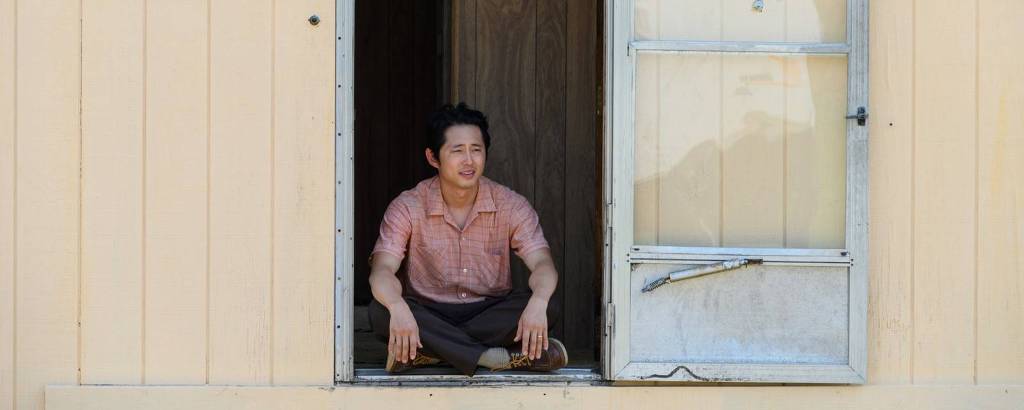
Homem sentado no vão de uma porta aberta

[RESUMO] Indicado a 6 Oscars, entre eles o de melhor filme, "Minari", falado em coreano, retrata a luta pela sobrevivência de imigrantes da Coreia do Sul nos EUA. Em entrevista, o diretor e o ator do filme, ambos de origem asiática, falam de como o sucesso do longa é um marco para levar mais diversidade a Hollywood e despertar o interesse das plateias por outras culturas.

Ana Maria Bahiana

As raízes de “Minari” —o filme estadunidense falado em coreano, indicado a seis Oscars, inclusive melhor filme— vêm do Arkansas, de Michigan, de Utah, de Ruanda.

“A Coreia do Sul é um espaço distante, mas presente”, diz o ator Steven Yeun, protagonista do filme, em uma entrevista remota via Zoom, de sua casa em Los Angeles. “Conversamos muito sobre isso, Lee [Isaac Chung, diretor e roteirista do filme] e eu. Estávamos contando uma história americana. Asiático-americana, mas americana, só que falada em coreano.”

Com uma bilheteria mundial de US$ 10,4 milhões (R$ 58,4 milhões) em plena pandemia, o quinto longa-metragem de Lee Isaac Chung fez muito mais do que agradar a críticos e colegas do meio cinematográfico. “Minari” fala diretamente a várias camadas de pessoas comuns, famílias, mães e pais, avós, crianças; é um pequeno épico em uma dimensão plausível, quase banal, o esforço para melhorar de vida.

“Eu não sabia o quanto eu ia aprender sobre mim mesmo, sobre minha família, quando estava fazendo ‘Minari’”, diz Lee (também via Zoom, também em Los Angeles). “Minari” concorre a 6 Oscars no próximo dia 25. Lee disputa as categorias de melhor diretor e melhor roteiro original.

“Quando escrevi o roteiro, não queria que fosse a história da minha família, queria que fosse outra família, uma nova família. Por isso, mudei os nomes e os detalhes do que aconteceu com minha família. Mas, ao mesmo tempo, as emoções começaram a vir à tona, sem parar, enquanto eu estava filmando.”

Lee Isaac Chung nasceu em Denver, no Colorado, filho de imigrantes da Coreia do Sul. Como os personagens de “Minari”, seus pais trabalhavam em uma empresa de processamento de galinhas. Quando Lee tinha 5 anos, seus pais se mudaram para Lincoln, no estado de Arkansas, uma região predominante rural no sul dos Estados Unidos.

Também como em “Minari”, o jovem pai da família Chung tinha sonhos de ter sua própria fazenda. Com eles seguiu a avó materna, a quem o cineasta dá o crédito de ter mantido “o idioma e a cultura da Coreia” dentro dele.

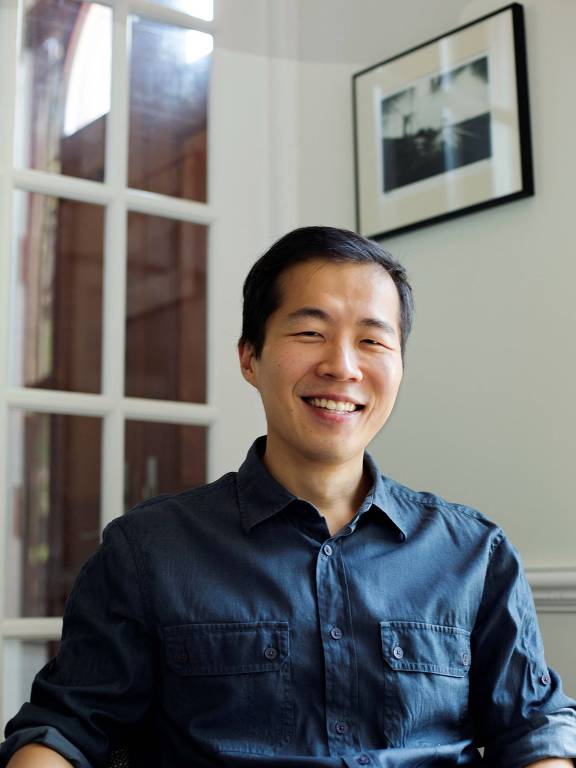
O diretor Lee Isaac Chung, diretor de 'Minari' - 28.out.2020/AFP/BIFF

“Minha avó não sabia inglês e nunca se interessou em aprender”, ele recorda. “Ela só falava coreano comigo e me ensinou tudo da minha cultura, inclusive os palavrões em coreano [ele ri muito]. Ela foi o espírito coreano, o espírito da sua geração. Ela foi essencial para mim.”

O contato com a natureza levou-o a estudar biologia na respeitada Universidade Yale. Sua primeira intenção era se tornar médico, mas, no meio do caminho, no contato com os alunos do programa de cinema e mídia da universidade, resolveu mudar de rumo. “Aí as coisas se complicaram”, conta. “Não tinha os créditos para me transferir para o curso de cinema.”

Lee saiu de Yale com um diploma de biólogo e um “desejo louco” de ser cineasta. “Meu pai não entendia nada do que tinha acontecido —’meu filho não ia ser médico?’”, ele recorda. “Mas minha mãe me dizia que eu era igual ao meu pai —eu era cabeça-dura e não abria mão de algo que eu realmente quisesse fazer. Como meu pai com a fazenda. Como o Jacob, de ‘Minari’.”

Chung se inscreveu em 15 universidades e foi rejeitado por todas elas. Finalmente, a menos conhecida Escola de Cinema da Universidade de Utah aceitou-o. “Eu fui muito sincero com eles e eles compreenderam minha paixão”, diz. “O fato de a escola ser pequena e menos conhecida foi algo positivo para mim, tinha muito mais liberdade para experimentar. Na minha carta de candidatura, escrevi que o cinema, para mim, era uma forma de ser útil para os outros. E acredito nisso.”

Cumprindo o que escreveu para a universidade, o primeiro filme de Lee foi o resultado de um gesto de apoio a quem precisa.

“Munyurangabo” (2007), a história de dois meninos tentando refazer suas vidas em um país massacrado, foi criado e realizado em breves 11 dias, a partir das aulas de cinema que o diretor ministrou em um campo de refugiados órfãos em Kigali, Ruanda. Seus jovens estudantes trabalharam como atores e operadores de câmera e som, e não atores do lugar colaboraram com o elenco.


The Oscars Are a Week Away, but How Many Will Watch?


 Nicole Sperling and — Neither intimate looks into stars’ living rooms nor scantily clad pop stars performing provocative hits have been able to stop audiences from tuning out award shows this year. The ratings for the Grammys were down by 53 percent. The Golden Globes plummeted by more than 60.

Now, as Hollywood prepares for a coronavirus-delayed Academy Awards telecast on April 25 on ABC, it is faced with the ultimate doomsday scenario: that the viewing public is ready to toss its premier showcase into the entertainment dustbin, plopped next to variety shows. Oscar, meet Lawrence Welk and his bubbles.

At a time when the traditional sinema industry is fighting for its primacy at the center of American culture — with at-home entertainment soaring in popularity and pandemic-battered theater chains closing — a collective shrug for the Oscars would send Hollywood deeper into an identity crisis. And a shrug certainly could happen. Guts + Veri, a research firm that focuses on entertainment, said last month that only 18 percent of active sinema watchers (in theaters or at home) had heard of “Mank,” the Netflix sinema leading the Oscar race with 10 nominations.

One survey found that just 18 percent of active sinema watchers had heard of the Netflix sinema “Mank,” which is leading the Oscar race with 10 nominations, including one for Amanda Seyfried.Credit…Netflix/Netflix, via Associated Press

“When even I find myself having a hard time caring, that’s a sorun,” said Jeanine Basinger, the founder of Wesleyan University’s sinema studies department and author of Hollywood histories like “The Star Machine.”

Some people in the entertainment industry, whether out of optimism or denial or both, believe that award shows are simply going through a temporary downturn because of the unique circumstances of the pandemic.

But Nielsen ratings for the Oscars were already in free fall before the pandemic, plunging 44 percent between 2014 and last year, when 23.6 million people watched the South Korean dramatic thriller “Parasite” win the top prize. An additional drop on a par with the Globes show in February would put the Oscars audience in the catastrophic single-digit millions.

Much more than vanity is at stake. The Academy Awards have long been an economy unto themselves, with companies like Netflix spending $30 million or more to campaign for a single sinema and Disney, which owns ABC, committed to paying more than $900 million for the worldwide broadcast rights through 2028.

Bong Joon Ho’s “Parasite” received the Academy Award for best picture in 2020.Credit…Noel West for The New York Times
 

The Academy of Motion Picture Arts and Sciences is not conceding defeat. The organization, which generates about $90 million a year in after-expenses income from the Oscars telecast, has handed the show to one of Hollywood’s most celebrated directors, Steven Soderbergh. He and his fellow producers, Stacey Sher and Jesse Collins, have been asked to shake up the telecast while also sticking to tradition (awarding statuettes in 24 categories, including the “boring” technical ones) and complying with pandemic safety restrictions.

If that wasn’t difficult enough, the three have the additional challenge of attempting to jump-start theatergoing when most of the world is more than a year out of the habit.

“If we can get out at three hours and deliver a show that we see on paper right now, we feel like we will have had a cultural moment where the nation, the world, will say, ‘Yes, I love movies!’” said Mr. Collins, a veteran live-events producer who oversaw both this year’s Üstün Bowl and the Grammys. “That will get us another step back to theaters.”

The three are trying to reinvent the show, yet are hamstrung by the Covid-19 safety costs, which alone are taking up a third of the production budget. The group is also adamant that the show will not take place over Zoom. Mr. Soderbergh, who directed the 2011 virus thriller “Contagion” and headed up the Directors Guild return-to-work task force, had that provision written into his contract when he signed on to the project.

The 2021 Oscars will be produced by Steven Soderbergh, a former best director winner.Credit…Stefanie Loos/Agence France-Presse — Getty Images

“I made it clear that that has to be the absolute worst-case scenario,” Mr. Soderbergh said of the ubiquitous pandemic technology. “It’s the Academy Awards. We all want it to be special, and that doesn’t feel special. It just doesn’t. It reminds us of the pain of the last 14, 15 months. Not the joy of cinema or going to the movies.”

In an attempt to make the show like an exclusive gathering, the producers are stepping into a logistical morass that will aim to get every nominee in front of a television camera at a designated location, whether at two in Los Angeles — the downtown Union Station and the usual Oscars location, the Dolby Theatre in Hollywood — or to one of 20 satellite spots around the world. (The largest hub will be in London.)

For Mr. Soderbergh, the decision to take the job at such a fraught time stems from his own long history of complaining about the show. Whether he was in the room as a nominee or at home watching it on television, “the lack of intimacy” always bothered him.

“I didn’t find it a very pleasant experience to be in the audience,” he said of his two visits, one in 1990 as the screenwriter of “Sex, Lies and Videotape” and again in 2001, when he won best director for “Traffic.”

Ms. Sher, who has attended the Academy Awards four times, remembers being awed at first in 1995, when she was an executive producer of “Pulp Fiction” and the movie was nominated for seven Oscars.

“When I got out of the car and saw those giant Oscars, it was one of the most mind-blowing moments in my life,” she said. “And it completely went downhill from there.”

This year, the producers want to focus less on winning and instead make mühlet the notably diverse group of nominees has a better-than-average time by making the event more communal and intimate. They also intend to create a mask-free telecast that reminds audiences at home why they like going to the movies.

Daniel Kaluuya accepting his best supporting actor Golden Globe over Zoom in February. A bad connection initially left him without sound.Credit…NBCUniversal, via Agence France-Presse — Getty Images

Not helping the producers’ cause is the slate of films they are celebrating. Even though the majority of the best picture contenders are available on streaming services, they remain relatively obscure. According to the Guts + Veri survey, conducted the week of March 21, the best-known contender was “Judas and the Black Messiah,” with 46 percent awareness. The front-runner, “Nomadland,” registered only 35 percent.

Mr. Soderbergh did acknowledge that there is only so much the producers can do.

“People’s decision-making process on whether to watch or not doesn’t seem to be connected to whether or not the show is fantastic or not,” he said, pointing to the strong critical response for this year’s Grammys, which notably featured a risqué performance by Megan Thee Stallion and Cardi B.

The Oscars telecast, on the other hand, saw its ratings peak in 1998, when 57.2 million people tuned in to see the box office juggernaut “Titanic” sweep to best-picture victory. Since the turn of the century, the most highly rated year was 2004, when the academy honored another box office behemoth, “Lord of the Rings: The Return of the King.”

Analysts point to a litany of challenges propelling the decline. Old broadcast networks like ABC are not as relevant, especially to young people. The ceremonies, even if kept to a relatively brisk three hours, are too long for contemporary attention spans. Last year’s Oscars ran three hours and 36 minutes (the equivalent of 864 videos on TikTok).

Why slog through the show when you can just watch snippets on Twitter and Instagram?

Moreover, the Oscars have become overly polished and predictable. “The Oscars used to be the only time when you got to see movie stars in your living room, and very frequently it was a hoot,” Ms. Basinger, the Hollywood historian, said. “Some seemed a little drunk. Some wore weird clothes. A few had hair hanging in their face.”

Increasingly, the ceremonies are less about entertainment honors and more about progressive politics, which inevitably annoys those in the audience who disagree. One recent producer of the Oscars, who spoke on the condition of anonymity to discuss confidential metrics, said minute-by-minute post-show ratings analysis indicated that “vast swaths” of people turned off their televisions when celebrities started to opine on politics.

And there is simply awards show fatigue. There are at least 18 televised ceremonies each year, including the MTV Görüntü Music Awards, BET Awards, Teen Choice Awards, Academy of Country Music Awards, Billboard Music Awards, CMT Music Awards, Tony Awards, People’s Choice Awards, Kids’ Choice Awards and Independent Spirit Awards.

With ratings expected to tumble for the coming telecast, ABC has been asking for $2 million for 30 seconds of advertising time, down about 13 percent from last year’s starting price. Some loyal advertisers (Verizon) are returning, but others (Ferrero chocolates) are not.

“We’re really not getting much advertiser interest,” said Michelle Chong, planning director at Atlanta-based agency Fitzco, “and it’s not something we’ve been pushing.”

NY TIMES